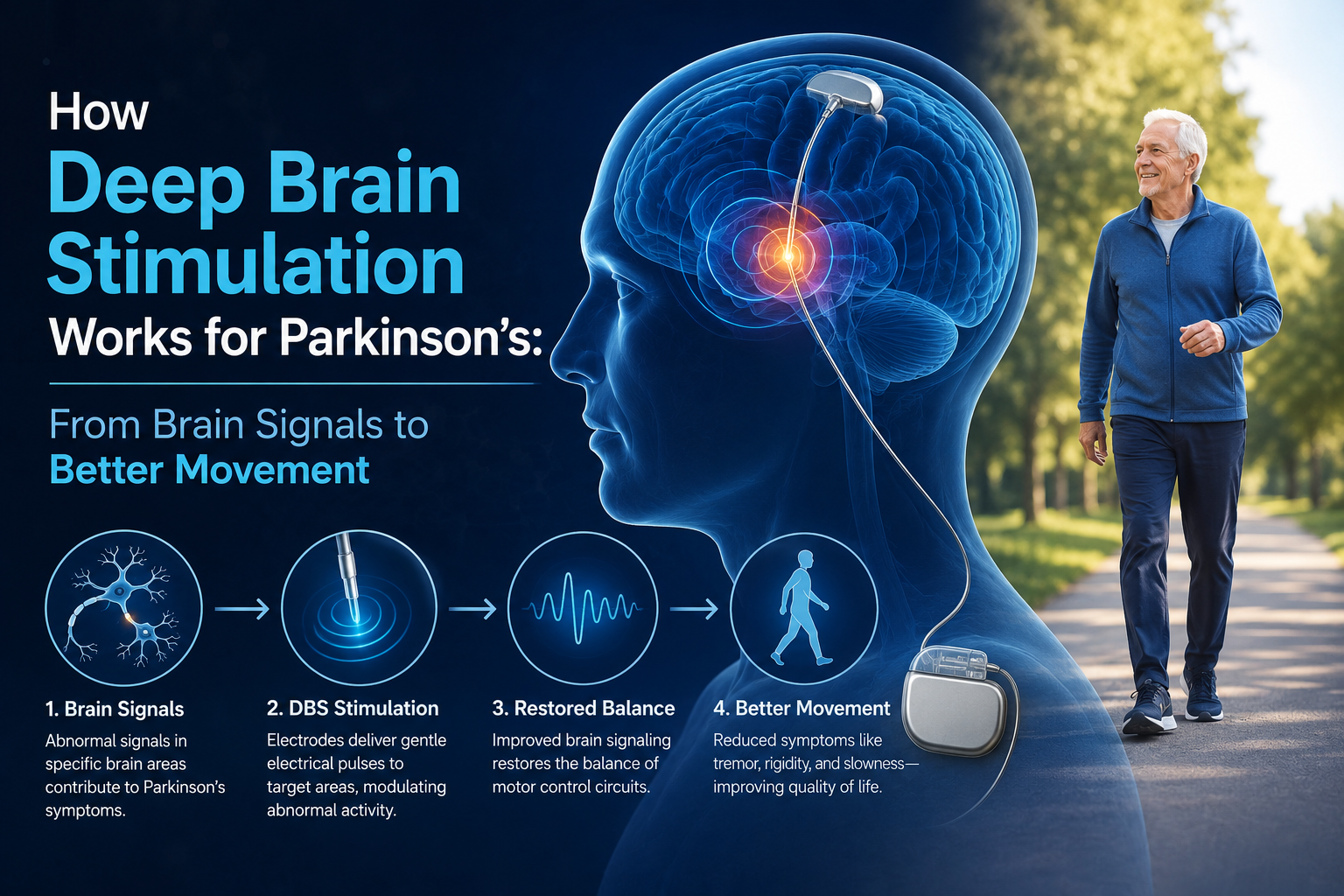
Parkinson’s disease is a progressive neurological disorder that affects movement, coordination, and, in many people, quality of life. Symptoms such as tremor, muscle stiffness, slowed movement, and balance problems can make everyday activities increasingly difficult. While medications such as levodopa remain an important part of Parkinson’s treatment, some people eventually experience fluctuations in symptom control or medication-related complications.
Deep brain stimulation (DBS) is an advanced treatment option that can help selected people with Parkinson’s disease manage certain movement symptoms. Rather than removing damaged brain tissue or continuously delivering medication, DBS uses carefully controlled electrical stimulation to influence abnormal activity within specific brain circuits.
But how does it actually work? How do electrical signals in the brain relate to better movement?
This article explains the process step by step—from the brain changes associated with Parkinson’s to how a DBS system delivers stimulation and how that stimulation can improve movement.
What Happens in the Brain During Parkinson’s Disease?
Click Here To Watch Video to Treat Parkinson’s Disease Naturally!..
To understand how DBS works, it helps to first understand what changes in Parkinson’s disease.
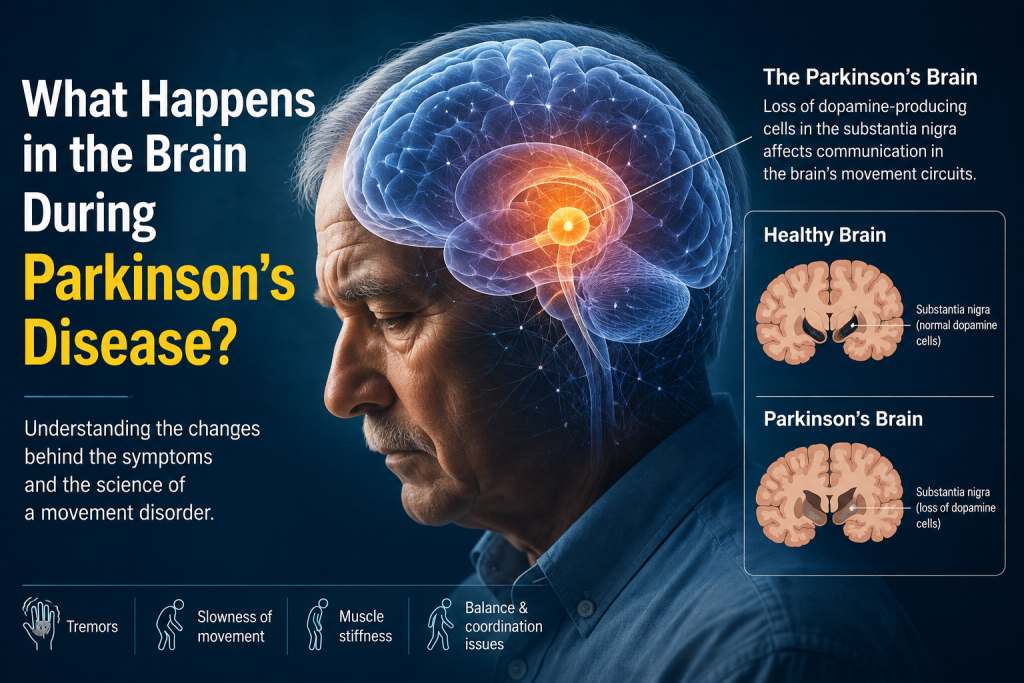
Deep inside the brain is a group of structures called the basal ganglia. These structures play an important role in controlling movement. They help the brain decide when to start a movement, how strongly to perform it, and when to stop.
One of the most important areas involved is the substantia nigra, which contains nerve cells that produce the chemical messenger dopamine.
In Parkinson’s disease, dopamine-producing nerve cells gradually become damaged or lost. As dopamine levels decline, communication between different parts of the movement-control system becomes abnormal.
This does not simply mean that the brain stops sending movement signals. Instead, the patterns and balance of activity within movement circuits become disrupted.
This disruption contributes to symptoms such as:
- Resting tremor
- Slowness of movement, known as bradykinesia
- Muscle rigidity or stiffness
- Difficulty initiating movement
- Changes in walking
- Certain medication-related movement complications
The goal of DBS is to influence these abnormal movement circuits and help restore a more functional pattern of activity.
What Is Deep Brain Stimulation?
Deep brain stimulation is a surgical treatment that uses a small implanted device to send electrical pulses to a specific area of the brain.
A typical DBS system has three main components:
- Electrodes (leads) placed in a targeted area of the brain
- Extension wires that connect the brain leads to the pulse generator
- A pulse generator, often implanted beneath the skin near the collarbone or in another suitable location
The pulse generator produces programmed electrical stimulation. The electrodes deliver that stimulation to the targeted brain region.
Unlike a traditional surgical procedure that removes tissue, DBS is designed to modulate the activity of neural circuits.
The exact target depends on the patient’s symptoms, medical history, and treatment goals.
How Does DBS Affect Brain Signals?
This is one of the most interesting aspects of deep brain stimulation.
The brain communicates through electrical and chemical signals. Neurons generate electrical activity and communicate with one another through highly organized networks.
Parkinson’s disease can disturb the normal activity of circuits involved in movement.
DBS delivers rapid electrical pulses that interact with these circuits. The stimulation can alter abnormal patterns of neuronal activity and influence communication between connected brain regions.
A useful way to think about DBS is like adjusting the activity of a malfunctioning circuit rather than simply turning the brain’s movement system “on” or “off.”
The stimulation can help reduce certain abnormal signals associated with Parkinsonian movement problems, allowing motor circuits to function more effectively.
Researchers continue to study exactly how DBS produces its effects. Its mechanism is complex and may involve changes in neuronal firing, network communication, and the transmission of signals through movement-related pathways.
The Main Brain Targets Used in Parkinson’s DBS

Click Here To Watch Video to Treat Parkinson’s Disease Naturally!..
DBS does not stimulate just any part of the brain. Specialists carefully select a target based on the person’s symptoms and treatment needs.
Two commonly used targets for Parkinson’s disease are the:
Subthalamic Nucleus (STN)
The subthalamic nucleus is a small structure involved in regulating movement through the basal ganglia.
STN DBS can improve several motor symptoms and may allow some patients to reduce their Parkinson’s medications under appropriate medical supervision.
However, reducing medication is not automatically the goal for every patient. Treatment is individualized according to symptoms, response, side effects, and overall health.
Globus Pallidus Internus (GPi)
Another important DBS target is the globus pallidus internus, or GPi.
GPi stimulation can be particularly useful for certain patients with troublesome dyskinesias—uncontrolled or involuntary movements that can occur after years of dopaminergic treatment.
Both STN and GPi stimulation can improve Parkinson’s motor symptoms, but the most appropriate target depends on several individual factors.
From Brain Signals to Better Movement: The DBS Process
So how does stimulation eventually translate into improved movement?
The process can be understood in several stages.
Step 1: Parkinson’s Changes Movement Circuits
As dopamine-producing neurons are lost, communication throughout the basal ganglia becomes disrupted.
The result is abnormal activity in circuits responsible for regulating voluntary movement.
This contributes to problems with initiating and controlling movement.
Step 2: Doctors Identify an Appropriate DBS Target
Before surgery, a multidisciplinary medical team evaluates whether DBS is appropriate.
This assessment may include:
- Neurological examinations
- Medication-response testing
- Brain imaging
- Cognitive evaluation
- Assessment of symptoms and daily functioning
- Review of medication-related complications
The medical team then determines whether DBS may provide meaningful benefits and identifies the appropriate target.
Step 3: Electrodes Are Precisely Positioned
During DBS surgery, thin electrodes are placed into the selected brain region.
Modern DBS surgery uses detailed imaging and specialized techniques to guide electrode placement.
Precision is extremely important because the brain structures involved are small and closely surrounded by other pathways.
The goal is to place the electrodes where stimulation can influence the desired motor circuits while minimizing unwanted effects.
Step 4: The Pulse Generator Delivers Electrical Stimulation
The electrodes are connected to a pulse generator implanted under the skin.
The generator sends programmed electrical pulses through the leads to the target area.
These pulses can influence abnormal neural activity within the motor network.
Importantly, the system does not replace dopamine. Instead, it works through a different mechanism by modulating neural circuits.
Step 5: Programming Is Customized
DBS treatment does not end when the device is implanted.
After surgery, specialists gradually program and adjust the stimulation settings.
Parameters may include factors such as stimulation amplitude, frequency, pulse width, and which electrode contacts are activated.
The goal is to find a balance between symptom improvement and minimizing side effects.
Programming can require multiple visits, especially during the early stages of treatment.
Which Parkinson’s Symptoms Can DBS Improve?
Click Here To Watch Video to Treat Parkinson’s Disease Naturally!..
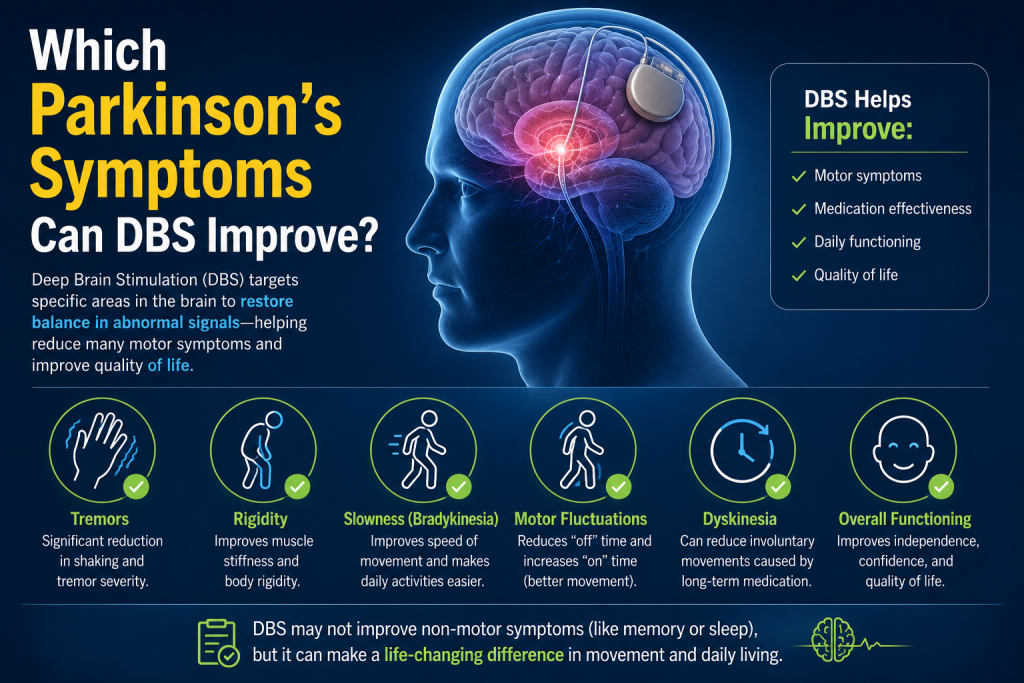
DBS is primarily used to treat certain motor symptoms of Parkinson’s disease.
Depending on the patient and DBS target, it can provide substantial improvement in symptoms such as:
- Tremor
- Rigidity
- Slowness of movement
- Motor fluctuations
- Certain forms of dyskinesia
For some people, DBS can make daily activities easier and provide more consistent periods of mobility.
However, DBS is not a cure for Parkinson’s disease.
It also does not necessarily improve every symptom of the condition.
For example, some non-motor symptoms—including certain cognitive, mood, speech, swallowing, or autonomic problems—may not respond to DBS and can sometimes require separate treatment.
Why Medication Response Matters
A person’s response to Parkinson’s medication is an important consideration when evaluating DBS.
Levodopa can provide significant improvement in many Parkinson’s motor symptoms. Over time, however, some patients experience “wearing-off,” where medication benefits do not last as long, or dyskinesias and other complications.
DBS may help smooth out some of these motor fluctuations and reduce the amount of time a person spends in poorly controlled “off” periods.
In carefully selected patients, DBS may also allow medication doses to be adjusted.
However, medication changes should always be made by the treating medical team. DBS does not mean that Parkinson’s medications can automatically be stopped.
What Happens After DBS Surgery?
After implantation, patients usually enter a period of adjustment.
The DBS system may be activated or programmed according to the clinical team’s treatment plan. Specialists then monitor symptoms and make adjustments when necessary.
Patients may notice improvements at different rates depending on the symptom being treated, stimulation settings, medications, and individual response.
Long-term follow-up is important because Parkinson’s disease continues to progress even when DBS successfully controls certain symptoms.
As symptoms change, medication and stimulation settings may need to be adjusted.
What Are the Risks of DBS?
Although DBS can be highly effective for appropriately selected patients, it is a major medical treatment and carries potential risks.
Because electrode implantation involves brain surgery, possible complications can include bleeding, infection, seizures, or other neurological problems.
There can also be stimulation-related side effects. Depending on the location and settings, stimulation may affect speech, balance, mood, sensation, or other functions.
The implanted hardware can also require monitoring and, eventually, maintenance or replacement of certain components.
For these reasons, DBS requires careful patient selection, surgical expertise, and long-term follow-up.
Who May Be a Candidate for DBS?
Click Here To Watch Video to Treat Parkinson’s Disease Naturally!..
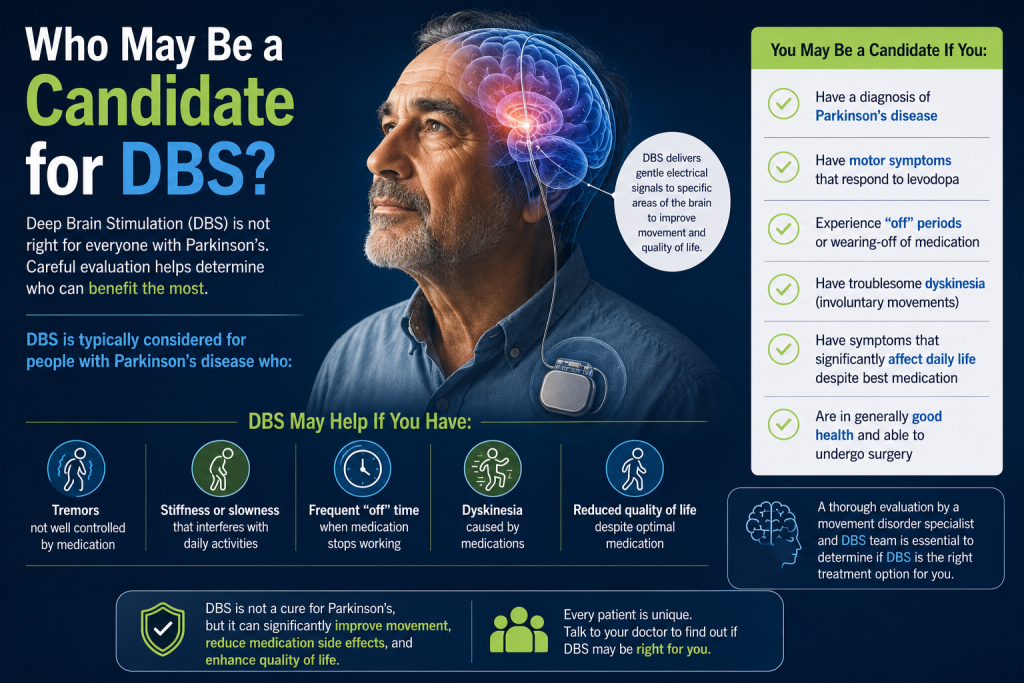
DBS is not appropriate for everyone with Parkinson’s disease.
Doctors typically consider factors such as:
- Diagnosis and symptom pattern
- Response to Parkinson’s medications
- Severity of motor fluctuations or tremor
- Medication-related complications
- Cognitive health
- Overall medical condition
- Ability to participate in follow-up and programming
The decision is usually made by a multidisciplinary team rather than through a single test.
An important point is that DBS is generally considered a treatment for selected patients whose symptoms are not adequately controlled with medication or who experience significant medication-related complications.
The Future of DBS
DBS technology continues to evolve.
Newer systems are being developed with more sophisticated programming capabilities, smaller hardware, rechargeable batteries, and improved methods for targeting and monitoring brain activity.
One exciting area of research involves adaptive or responsive DBS, in which stimulation may be adjusted according to signals detected from the brain.
The long-term goal is to make stimulation more personalized and responsive to changes in a patient’s symptoms and neural activity.
These developments could make DBS more precise and potentially improve its usefulness for people living with Parkinson’s disease.
Final Thoughts
Deep brain stimulation works by influencing abnormal activity within the brain circuits responsible for movement. Parkinson’s disease disrupts these circuits partly because of the loss of dopamine-producing neurons. DBS does not restore those neurons or cure the disease. Instead, it delivers carefully controlled electrical stimulation to specific brain regions to help regulate dysfunctional motor networks.
From selecting the appropriate brain target to implanting electrodes and fine-tuning stimulation, DBS is a highly individualized treatment.
For people with Parkinson’s who experience significant motor symptoms, medication fluctuations, tremor, or dyskinesia, DBS may provide meaningful improvements in movement and quality of life when they are appropriately selected for the procedure.
If you or someone you know is considering DBS, the best next step is to discuss the potential benefits, limitations, and risks with a movement-disorders neurologist and a DBS-experienced medical team.