For people living with Parkinson’s disease, focused ultrasound can offer a treatment option for certain movement symptoms without the need for a traditional open brain surgery or an implanted stimulation device. But one of the most common questions patients have before treatment is: How long does it take to recover from focused ultrasound for Parkinson’s?
The short answer is that recovery can be relatively quick compared with many conventional surgical procedures, but the exact timeline varies from person to person. Some patients can return home after a period of observation on the same day, while others may need additional monitoring or rehabilitation if they experience temporary side effects.
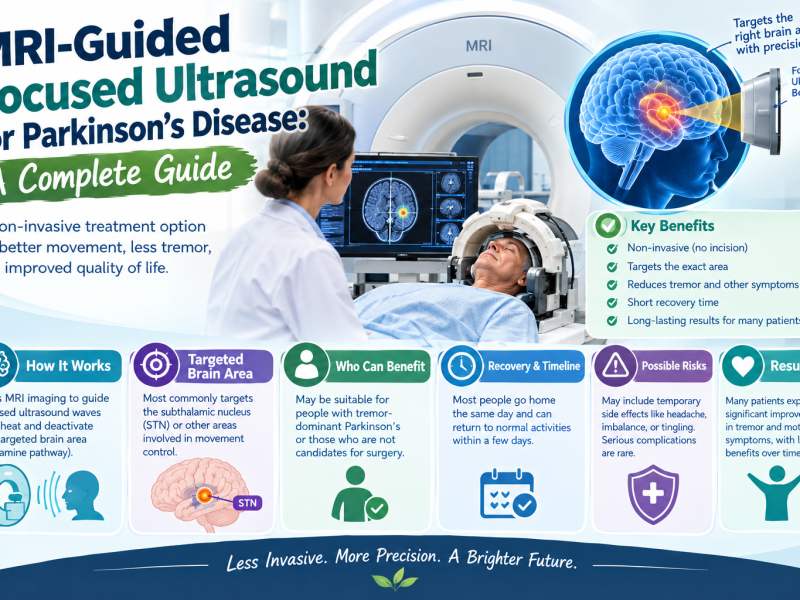
Focused ultrasound is a specialized procedure that uses concentrated ultrasound energy to create a precisely controlled lesion in a targeted area of the brain. The procedure is performed while the patient is monitored with MRI, allowing the medical team to identify the treatment area and monitor the effects of the ultrasound.
Recovery depends on several factors, including the brain target, the patient’s overall health, the symptoms being treated, and whether temporary side effects occur.
What Is Focused Ultrasound for Parkinson’s Disease?
Magnetic resonance-guided focused ultrasound (MRgFUS) is a minimally invasive brain procedure that uses high-intensity ultrasound waves to heat and ablate a carefully selected area of brain tissue.
Unlike deep brain stimulation (DBS), focused ultrasound does not require implanted electrodes, extension wires, or a pulse generator. Instead, the treatment creates a permanent lesion in a specific brain pathway involved in movement.
Focused ultrasound can be used as a lesion-based treatment for selected Parkinson’s patients. Depending on the procedure and regulatory indication, targets may include structures or pathways involved in tremor and other motor complications. The Parkinson’s Foundation notes that focused ultrasound and other lesion therapies may be considered for certain movement symptoms when medications and standard treatments are no longer sufficiently effective.
The FDA has also authorized certain MR-guided focused ultrasound procedures for specific Parkinson’s indications, including unilateral pallidothalamic tractotomy for selected adults with advanced Parkinson’s disease and medication-refractory motor complications.
Because different focused-ultrasound procedures treat different symptoms, recovery should always be discussed with the treating medical team.
How Long Does Focused Ultrasound Recovery Take?
Click Here To Watch Video to Treat Parkinson’s Disease Naturally!..
There is no single recovery timeline that applies to every patient.
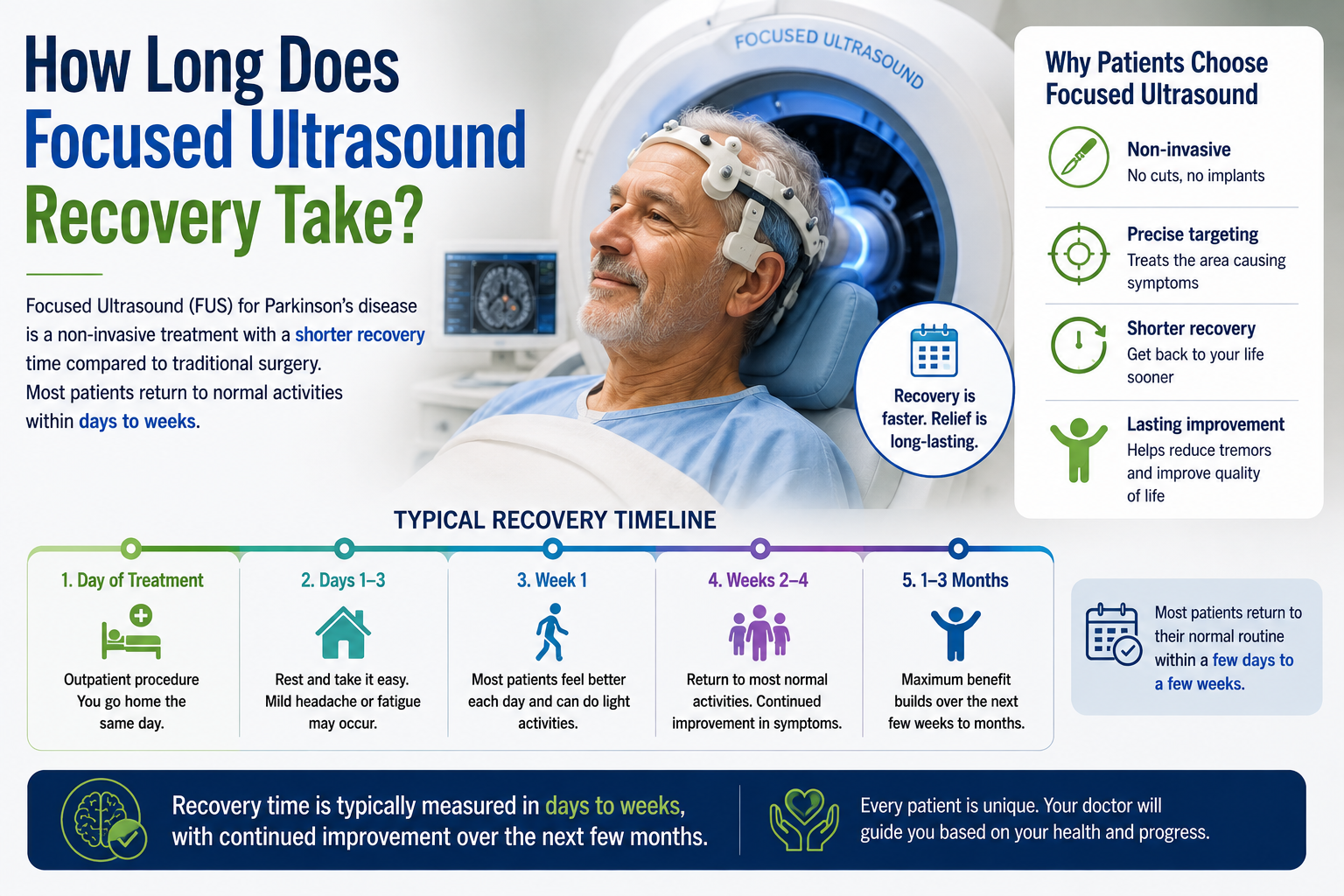
In many cases, the immediate recovery period is measured in hours to days rather than weeks. After the procedure, patients are monitored for several hours before the medical team decides whether they can safely go home. The FDA’s patient information for the Exablate Neuro system states that patients are moved to a recovery area for observation for several hours after treatment, with discharge determined by the treating physician.
However, feeling comfortable enough to go home is not the same as being completely recovered.
Temporary symptoms such as headache, nausea, fatigue, dizziness, imbalance, numbness, or other neurological effects can occur after focused ultrasound. Some resolve quickly, while others can take days or weeks to improve.
Therefore, it is helpful to think about recovery in stages.
The First Few Hours After Treatment
Immediately after focused ultrasound, the patient is taken out of the MRI system and the stereotactic frame is removed.
The medical team checks vital signs and performs neurological assessments. Patients may be observed for several hours to make sure they are stable and that there are no concerning complications.
Some people may experience:
- Headache
- Nausea
- Fatigue
- Dizziness
- Temporary discomfort
- Mild balance problems
- Temporary numbness or tingling
The experience varies considerably.
If the patient is stable and the treating team is satisfied with the recovery, discharge may occur later that day. In some circumstances, overnight observation may be recommended.
The First 24 to 48 Hours
The first couple of days are generally focused on rest, monitoring, and following the medical team’s instructions.
Patients may feel tired after the procedure. Headaches or other temporary symptoms may still be present.
The FDA patient guide advises patients to contact their physician for severe pain, lightheadedness, discomfort, or fever of 100°F or higher within 48 hours.
During this period, it is important not to judge the entire treatment outcome based on how the patient feels immediately after the procedure.
The brain can experience temporary swelling around the treatment area. Some neurological effects can therefore change during the first days and weeks.
The First Week of Recovery
For many patients, the first week is when the body begins settling after treatment.
Some people feel well enough to gradually resume ordinary activities relatively quickly. Others may need more time, particularly if they experience fatigue, balance difficulties, headache, or other temporary symptoms.
The FDA’s clinical safety information for focused ultrasound reports that some procedure-related events resolved within days, while other events could take longer. Among reported adverse events, some resolved within approximately one week to three months.
This wide range demonstrates why it is difficult to give every patient a specific recovery date.
A person who has minimal side effects may feel substantially recovered within several days, while another patient may need several weeks for particular symptoms to settle.
Recovery During the First Few Weeks
The first few weeks can be an important period of neurological adjustment.
Some side effects may gradually decrease as temporary tissue changes around the treatment area resolve.
Possible symptoms can include:
- Changes in balance
- Temporary weakness
- Speech changes
- Numbness or altered sensation
- Fatigue
- Headache
- Coordination difficulties
Not every patient experiences these effects, and many are temporary. However, neurological symptoms should never simply be assumed to be normal without appropriate medical evaluation.
FDA records describe cases in which neurological side effects improved over several weeks. In one reported case, weakness and speech changes improved sufficiently for the patient to be discharged about two weeks after treatment.
These individual reports should not be interpreted as a typical recovery timeline, but they illustrate why recovery can differ significantly between patients.
When Do Patients Notice Improvement?

Click Here To Watch Video to Treat Parkinson’s Disease Naturally!..
One of the advantages of focused ultrasound is that symptom improvement can sometimes be noticeable during or shortly after treatment.
Because the procedure creates a lesion in a specific movement pathway, the treatment effect does not depend on gradually charging or programming an implanted device in the way DBS does.
However, the immediate treatment effect and the final outcome are not necessarily the same.
Temporary swelling or neurological side effects can influence symptoms during the early recovery period. The medical team may therefore evaluate the patient’s progress over time rather than judging success solely on the day of treatment.
Follow-up appointments allow doctors to assess movement, balance, speech, tremor, and other relevant symptoms.
Why Recovery Can Vary From Person to Person
Several factors influence focused ultrasound recovery time.
1. The Treatment Target
The brain region being treated matters. Different targets are associated with different symptoms and potential side effects.
For example, focused ultrasound procedures may target pathways associated with tremor or motor complications. The Parkinson’s Foundation explains that different lesion therapies are used for different Parkinson’s symptoms.
2. The Patient’s Overall Health
Age, general health, mobility, and other medical conditions can influence how quickly someone returns to normal activities.
A patient who is already experiencing balance or walking problems may need more time and support after treatment.
3. Temporary Brain Swelling
The treatment intentionally creates a lesion, and temporary changes around the treatment area can occur.
These changes may contribute to temporary neurological symptoms. As the surrounding tissue settles, some symptoms may improve.
4. The Presence of Side Effects
Patients who experience significant dizziness, weakness, speech changes, numbness, or balance difficulties may require additional observation, therapy, or follow-up.
5. Rehabilitation Needs
Some patients may benefit from physical, occupational, or speech therapy if neurological symptoms affect walking, balance, coordination, or communication.
Can You Walk After Focused Ultrasound?
Many patients are able to walk after the procedure, but walking ability should be assessed by the medical team before discharge.
Balance problems can occur following focused ultrasound, and some patients may temporarily require assistance.
The ability to walk independently before treatment does not guarantee that there will be no temporary change afterward.
For this reason, patients should follow the discharge instructions provided by their medical team and avoid activities that could increase the risk of falling until they are cleared.
When Can You Return to Normal Activities?
The timing for returning to normal activities varies.
Some patients may resume light daily activities relatively soon, while others need several days or longer.
The safest approach is to follow individualized instructions from the treating center rather than relying on a fixed number of days.
Activities such as driving, strenuous exercise, heavy lifting, or returning to work should be discussed with the treating physician.
If balance, coordination, vision, speech, or other neurological functions have changed, the patient may need to wait until those symptoms have improved before resuming certain activities.
Does Focused Ultrasound Require Physical Therapy?

Click Here To Watch Video to Treat Parkinson’s Disease Naturally!..
Not everyone needs physical therapy after focused ultrasound.
However, therapy may be recommended if the patient develops temporary balance, walking, coordination, or strength problems.
Physical therapy can help patients safely regain confidence and mobility when appropriate.
Occupational therapy may also help with everyday tasks, while speech therapy can be useful for patients who experience speech or swallowing difficulties.
The need for rehabilitation depends on the individual patient’s symptoms and recovery.
What Side Effects Can Affect Recovery?
Focused ultrasound is non-invasive in the sense that it does not require an incision through the skull, but it is still a brain procedure and can have important risks.
Potential side effects include headache, nausea, dizziness, numbness, weakness, balance problems, speech difficulties, and other neurological effects.
The FDA notes that because MRgFUS creates an irreversible lesion, unintended effects on nearby structures can potentially result in persistent neurological problems.
Some side effects may resolve quickly, while others can persist.
Patients should therefore understand both the potential benefits and risks before choosing treatment.
When Should You Contact Your Doctor?
After focused ultrasound, patients should have clear instructions about when to contact their medical team.
Seek medical advice promptly if symptoms are severe, worsening, unexpected, or significantly interfere with daily activities.
The FDA patient guide specifically advises contacting the physician for severe pain, lightheadedness, discomfort, or a fever of 100°F or higher within 48 hours.
New or worsening neurological symptoms should also be evaluated rather than being automatically attributed to normal recovery.
Focused Ultrasound Recovery vs. DBS Recovery

Click Here To Watch Video to Treat Parkinson’s Disease Naturally!..
Focused ultrasound and DBS are very different treatments.
Focused ultrasound creates a lesion in a targeted brain area and does not require an implanted pulse generator. DBS involves implanting electrodes and a stimulation system that can be adjusted over time.
Because focused ultrasound does not involve implanted hardware or the same type of surgical implantation as DBS, the immediate physical recovery may be shorter for some patients.
However, focused ultrasound creates an irreversible lesion, while DBS provides adjustable stimulation that can be modified after implantation.
Neither approach is automatically better for every person. The right treatment depends on the patient’s symptoms, medical history, treatment goals, eligibility, and preferences.
What Should You Expect at Follow-Up Appointments?
Follow-up care is an important part of recovery.
Your medical team may evaluate:
- Tremor
- Rigidity
- Slowness of movement
- Walking
- Balance
- Speech
- Coordination
- Medication response
- Possible side effects
- Overall quality of life
Follow-up also helps doctors determine whether additional rehabilitation or medication adjustments are necessary.
The exact schedule varies by treatment center and procedure.
Frequently Asked Questions
Is focused ultrasound recovery faster than DBS recovery?
The immediate recovery can be shorter because focused ultrasound does not require implanted hardware. However, the procedures are fundamentally different, and recovery depends on the individual and the specific focused-ultrasound treatment.
Can I go home the same day?
Some patients can go home after several hours of observation if their medical team determines that they are stable. Others may need additional observation.
How long does dizziness last after focused ultrasound?
Dizziness varies from person to person. It may resolve quickly in some patients but can persist longer in others. Persistent or severe dizziness should be discussed with the treating medical team.
How long does it take for balance problems to improve?
Temporary balance problems can improve as the brain recovers from treatment-related effects, but the timeline varies. Some neurological effects may last weeks or longer.
Is focused ultrasound a cure for Parkinson’s disease?
No. Focused ultrasound is a treatment for selected Parkinson’s symptoms or motor complications. It does not cure Parkinson’s disease or stop the underlying progression of the condition.
Final Thoughts
So, how long does it take to recover from focused ultrasound for Parkinson’s?
For many patients, the immediate recovery period is relatively short, and observation after treatment may last only several hours. Some people can return home the same day. However, complete recovery can take longer, particularly when temporary neurological symptoms such as dizziness, imbalance, numbness, weakness, headache, or speech changes occur.
Available FDA information shows that procedure-related side effects can range from short-lived symptoms lasting hours or days to effects that take weeks or, in some cases, months to resolve.
The most important point is that there is no single recovery timeline for everyone.
Your recovery depends on the type of focused-ultrasound procedure, the brain target, your overall health, the symptoms being treated, and whether complications or temporary side effects occur.
If you are considering focused ultrasound for Parkinson’s disease, discuss the expected recovery timeline with an experienced movement-disorders team. Ask specifically about when you can walk independently, drive, return to work, exercise, resume medications, and return to your usual activities. A personalized recovery plan can give you a much more accurate expectation than a general timeline.