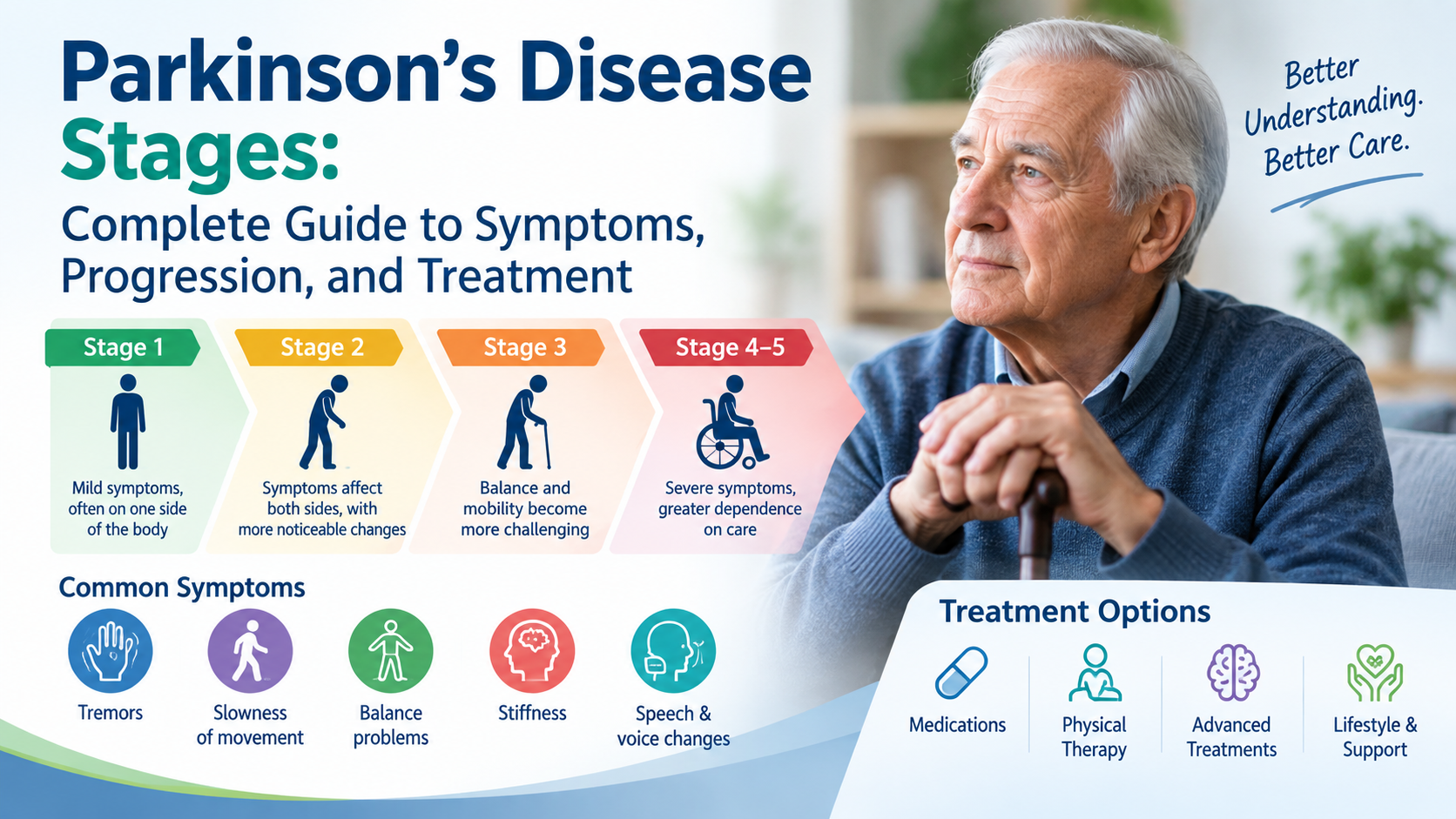
Parkinson’s disease is a progressive neurological disorder that affects movement as well as many non-movement functions. Symptoms can include tremor, stiffness, slowed movement, balance problems, changes in walking, speech difficulties, sleep problems, constipation, mood changes, and cognitive symptoms.
One of the most commonly used ways to describe the progression of Parkinson’s disease is the Hoehn and Yahr five-stage scale. It divides Parkinson’s into five broad stages based mainly on motor symptoms, balance, mobility, and functional independence. However, Parkinson’s does not progress in exactly the same way for everyone. Some people remain relatively independent for many years, while others develop significant mobility or non-motor problems sooner. (Parkinson’s Foundation)
Understanding the stages can help people with Parkinson’s, family members, and caregivers recognize changes, prepare for future needs, and discuss treatment options with a healthcare professional.
Medical disclaimer: This article is for educational purposes and is not a substitute for diagnosis or individualized medical advice. Parkinson’s symptoms and treatment needs vary considerably. Medication changes, exercise programs, surgery, or other treatments should be discussed with a qualified healthcare professional.
What Are the 5 Stages of Parkinson’s Disease?
The five stages of Parkinson’s disease are based on the Hoehn and Yahr scale, originally developed in 1967. The scale primarily describes the progression of motor disability.
In broad terms:
- Stage 1: Mild symptoms, usually affecting one side of the body.
- Stage 2: Symptoms affect both sides, but the person generally remains independent.
- Stage 3: Balance problems become prominent, although independent movement is often still possible.
- Stage 4: Severe disability develops, and substantial assistance with daily activities is usually needed.
- Stage 5: The most advanced stage, often involving wheelchair use or being unable to stand or walk without assistance.
The Parkinson’s Foundation considers stages 1 and 2 generally early-stage, stages 2 and 3 mid-stage, and stages 4 and 5 advanced-stage Parkinson’s. (Parkinson’s Foundation)
Importantly, these stages should not be interpreted as a precise timetable. A person can experience substantial symptoms that do not fit neatly into one stage. The scale also does not fully describe non-motor symptoms such as sleep problems, depression, constipation, urinary symptoms, cognitive changes, swallowing difficulties, or autonomic problems.
Doctors may therefore use additional assessments, including the Movement Disorder Society-Unified Parkinson’s Disease Rating Scale (MDS-UPDRS), to evaluate movement, non-movement symptoms, daily activities, and treatment complications. (Parkinson’s Foundation)
Parkinson’s disease stages at a glance
| Stage | Typical motor features | Independence |
|---|---|---|
| Stage 1 | Mild, usually one-sided symptoms | Generally independent |
| Stage 2 | Symptoms on both sides; posture and walking may change | Usually independent |
| Stage 3 | Balance problems and increased fall risk | Often independent but with limitations |
| Stage 4 | Severe motor disability | Significant assistance usually needed |
| Stage 5 | Severe mobility limitations | Extensive or around-the-clock assistance |
The table represents the typical Hoehn and Yahr pattern rather than a prediction for an individual person. (Parkinson’s Foundation)
Parkinson’s Disease Stage 1
Stage 1 is generally considered the earliest clinically recognizable stage of Parkinson’s disease.
Symptoms are usually mild and tend to affect one side of the body. A person may notice a tremor in one hand, stiffness in one limb, or subtle changes in movement.
Common symptoms in Stage 1
Possible symptoms include:
- Tremor affecting one hand, arm, leg, or another area
- Mild muscle rigidity
- Slightly slower movement
- Reduced arm swing on one side
- Small changes in posture
- Subtle changes in walking
- Reduced facial expression
- Changes in handwriting
- Mild changes in fine motor tasks
A person may still work, drive, exercise, socialize, and manage household responsibilities without significant assistance.
The Parkinson’s Foundation describes Stage 1 as a period when mild symptoms generally do not interfere substantially with daily activities. (Parkinson’s Foundation)
What does walking look like in Stage 1?
Walking may appear almost normal. However, subtle changes can develop.
Someone might:
- Swing one arm less while walking.
- Take slightly smaller steps on one side.
- Move more slowly.
- Have difficulty turning quickly.
- Notice stiffness after sitting for a long period.
These changes can be so subtle that family members may notice them before the individual recognizes them.
Daily activities during Stage 1
Most people remain independent.
They may be able to:
- Cook
- Shower
- Dress
- Shop
- Work
- Drive, when otherwise medically appropriate
- Exercise
- Manage medications
- Handle finances
Tasks that require fine motor control may take slightly longer.
For example, buttoning clothing, handwriting, typing, opening containers, or using utensils may become more difficult.
Treatment during Stage 1
Treatment is individualized. Some people with mild symptoms may initially be monitored, while others may benefit from medication if symptoms interfere with work, daily life, or quality of life.
Exercise and rehabilitation can also be important components of care.
Physical therapy can help address movement, flexibility, strength, posture, and balance. Occupational therapy can help with daily tasks, while speech therapy may become useful when voice or swallowing changes appear.
There is currently no cure for Parkinson’s disease, but treatments can relieve symptoms and help maintain quality of life. (nhs.uk)
Parkinson’s Disease Stage 2
In Stage 2, Parkinson’s symptoms generally become more noticeable and affect both sides of the body or the body’s midline.
The person can usually continue living independently, but everyday activities may take more time and effort.
Common Stage 2 symptoms
Symptoms can include:
- Bilateral tremor
- Muscle stiffness
- Bradykinesia, or slowed movement
- Changes in posture
- Smaller steps
- Reduced arm swing
- Difficulty turning
- Changes in facial expression
- Softer speech
- Reduced handwriting size
- Difficulty with fine motor activities
- Increased fatigue
The Parkinson’s Foundation notes that Stage 2 may involve more obvious walking and posture problems while the person remains capable of living alone. (Parkinson’s Foundation)
Changes in posture
Postural changes can become increasingly noticeable.
A person may begin to:
- Lean forward while standing
- Bend the neck forward
- Keep the elbows closer to the body
- Walk with smaller steps
- Have difficulty maintaining an upright posture
These changes can contribute to discomfort and may eventually affect balance.
Stage 2 and freezing
Freezing of gait can occur in Parkinson’s, although its timing varies considerably.
Freezing refers to a temporary inability or marked difficulty initiating or continuing movement, particularly while walking.
It may occur when:
- Starting to walk
- Turning
- Approaching a doorway
- Moving through a crowded area
- Changing direction
- Performing multiple tasks at once
Freezing can increase the risk of falls and should be discussed with a healthcare professional.
Daily life during Stage 2
A person can often continue most daily activities but may need more time.
For example:
Morning routine: Getting dressed may take longer.
Cooking: Chopping vegetables or handling small objects may be slower.
Work: Typing, writing, walking around an office, or maintaining concentration may become more tiring.
Exercise: Some movements may require modifications.
Driving: Driving safety should be evaluated individually, especially if reaction time, movement control, vision, sleepiness, cognition, or medications become concerns.
Stage 2 treatment
Treatment may include medications and rehabilitation depending on symptoms.
Carbidopa-levodopa is commonly used to improve Parkinson’s movement symptoms. Levodopa is converted into dopamine in the brain, while carbidopa helps reduce some peripheral side effects. (Parkinson’s Foundation)
Other medications can include dopamine agonists, MAO-B inhibitors, COMT inhibitors, amantadine, and other therapies depending on the individual’s symptoms and medical circumstances. (Parkinson’s Foundation)
Parkinson’s Disease Stage 3
Stage 3 is commonly considered a mid-stage of Parkinson’s disease.
The defining feature is generally loss of balance or postural instability.
A person may still be physically capable of living independently, but falls and mobility problems become more significant.
Major symptoms of Stage 3
Common problems may include:
- Increased balance difficulties
- Falls
- Freezing of gait
- Slower walking
- Smaller steps
- Greater muscle stiffness
- More noticeable tremor
- Difficulty turning
- Reduced ability to recover from a loss of balance
- Increasing difficulty with daily activities
The Parkinson’s Foundation identifies balance loss as the hallmark of Stage 3 and notes that falls become more common. (Parkinson’s Foundation)
Why balance becomes important
In earlier stages, a person may be able to compensate for movement changes.
By Stage 3, postural instability can make ordinary activities more challenging.
For example, standing up quickly, turning around, stepping over an object, or walking on an uneven surface may increase the risk of losing balance.
Falls in Stage 3
Falls are an important concern.
Fall prevention strategies may include:
- Removing loose rugs
- Improving lighting
- Installing grab bars where appropriate
- Keeping walking paths clear
- Using appropriate footwear
- Reviewing medications with a clinician
- Working with a physical therapist
- Using a walking aid when recommended
- Avoiding unnecessary multitasking while walking
Physical therapy can help develop individualized strategies for strength, balance, gait, and mobility. (Parkinson’s Foundation)
Stage 3 medication changes
Some people develop motor fluctuations after several years of treatment.
These can involve:
- “On” periods, when medication provides better symptom control
- “Off” periods, when symptoms return as medication wears off
- Dyskinesia, or involuntary movements
The timing varies widely.
The Parkinson’s Foundation notes that motor fluctuations may become an issue around five to 10 years after diagnosis for some people, while other people experience them at different times. (Parkinson’s Foundation)
Rehabilitation in Stage 3
Rehabilitation becomes particularly valuable.
A healthcare team may include:
- Neurologist or movement-disorder specialist
- Physical therapist
- Occupational therapist
- Speech-language pathologist
- Dietitian
- Mental health professional
- Social worker
Speech therapy can address reduced voice volume and communication difficulties. It can also help with swallowing problems when appropriate.
Occupational therapy can focus on dressing, bathing, cooking, handwriting, workplace activities, and home safety.
Parkinson’s Disease Stage 4
Stage 4 represents advanced Parkinson’s disease with severe functional limitations.
At this stage, symptoms can significantly interfere with independence.
According to the Hoehn and Yahr description, a person may still be able to stand and walk without assistance, but substantial help with daily activities is often needed. (Parkinson’s Foundation)
Common Stage 4 symptoms
Possible symptoms include:
- Severe bradykinesia
- Significant rigidity
- Frequent freezing
- Severe balance impairment
- Falls
- Difficulty standing from a chair
- Difficulty walking independently
- Reduced ability to perform household tasks
- Increased dependence on caregivers
- Speech difficulties
- Swallowing problems
- Greater fatigue
- Medication fluctuations
- Dyskinesia
- Non-motor complications
Not everyone experiences all of these problems.
Walking in Stage 4
Walking may still be possible, but it may require:
- A cane
- A walker
- Supervision
- Physical assistance
- Environmental modifications
A person may have difficulty turning, getting through doorways, or initiating movement.
Walking aids should ideally be selected with professional guidance because the wrong device or technique can sometimes increase fall risk.
Daily activities
Many routine tasks become significantly harder.
These can include:
- Showering
- Dressing
- Preparing meals
- Using the bathroom
- Getting into or out of bed
- Managing medications
- Shopping
- Cleaning
- Walking outdoors
The Parkinson’s Foundation recommends adapting daily routines and the home environment as mobility becomes more difficult. (Parkinson’s Foundation)
Advanced treatment considerations
If medications are no longer providing consistent control, clinicians may consider advanced therapies.
Depending on the individual, options can include:
- Adjustments to carbidopa-levodopa
- Additional medications
- Infusion or pump-based therapies
- Deep brain stimulation
- Focused ultrasound
- Rehabilitation
- Speech and swallowing therapy
- Occupational therapy
- Physical therapy
Advanced treatments are not automatically tied to one specific Hoehn and Yahr stage. Eligibility depends on symptoms, medication response, overall health, cognitive status, treatment goals, and other factors.
Deep brain stimulation, for example, can reduce certain movement symptoms and medication-related fluctuations in appropriate candidates. (Parkinson’s Foundation)
Parkinson’s Disease Stage 5
Stage 5 is the most advanced stage in the traditional Hoehn and Yahr scale.
Mobility can become extremely limited.
A person may be unable to stand or walk without assistance because of severe stiffness, balance problems, freezing, weakness, or other complications.
The Parkinson’s Foundation describes Stage 5 as potentially involving wheelchair use or being bedridden unless assistance is provided, with extensive care required for daily activities. (Parkinson’s Foundation)
Common Stage 5 challenges
Possible problems include:
- Severe mobility impairment
- Inability to walk independently
- Difficulty standing
- Frequent falls
- Significant rigidity
- Freezing
- Difficulty transferring between bed and chair
- Difficulty eating
- Swallowing difficulties
- Speech impairment
- Cognitive changes in some people
- Sleep disturbances
- Constipation
- Urinary problems
- Blood pressure regulation problems
- Increased dependence on caregivers
Wheelchair use
A wheelchair may become necessary when walking is no longer safe or practical.
Wheelchair use should not automatically mean that the person should stop participating in movement.
A physical therapist can help identify safe movement options and appropriate equipment.
Bed mobility
Turning over in bed, sitting up, transferring to a chair, and changing position can become challenging.
Caregivers may need professional instruction to prevent injuries to both the person with Parkinson’s and themselves.
Eating and swallowing
Swallowing problems can become increasingly important in advanced Parkinson’s.
Possible warning signs include:
- Coughing during meals
- Choking
- Wet or gurgly voice after swallowing
- Taking a very long time to eat
- Unexplained weight loss
- Avoiding certain foods
- Repeated respiratory infections
A speech-language pathologist can evaluate swallowing and recommend appropriate strategies.
Care at Stage 5
Care may become comprehensive.
It may involve:
- Medication administration
- Assistance with dressing
- Bathing
- Toileting
- Transfers
- Meal preparation
- Feeding assistance
- Mobility support
- Skin care
- Appointment coordination
- Communication with healthcare professionals
Advance care planning can also help families understand and respect the individual’s preferences as care needs increase.
Parkinson’s Disease Stages Chart
The following simplified chart summarizes the traditional five-stage progression.
| Parkinson’s Stage | Main Characteristics | Walking | Daily Independence |
|---|---|---|---|
| Stage 1 | Mild, usually one-sided symptoms | Usually normal or mildly changed | Mostly independent |
| Stage 2 | Symptoms on both sides; posture and gait changes | Generally independent | Independent but tasks take longer |
| Stage 3 | Balance problems and falls become important | Walking usually possible but less stable | Some limitations |
| Stage 4 | Severe disability | Walking may require assistance or a device | Significant help needed |
| Stage 5 | Very advanced disability | Often wheelchair-bound or unable to walk without assistance | Extensive assistance required |
This chart is a general representation of the Hoehn and Yahr scale. It should not be used to determine an individual’s stage without professional evaluation. (Parkinson’s Foundation)
Important limitation of the stages chart
A major limitation is that Parkinson’s includes much more than movement symptoms.
For example, two people with similar walking abilities may have very different:
- Sleep problems
- Cognitive symptoms
- Depression
- Anxiety
- Blood pressure problems
- Constipation
- Urinary symptoms
- Speech difficulties
- Swallowing problems
- Pain
This is why modern clinical assessments often evaluate both motor and non-motor symptoms. (Parkinson’s Foundation)
How Fast Does Parkinson’s Disease Progress?
There is no single progression rate for Parkinson’s disease.
Some people experience relatively slow changes over many years, while others develop significant disability more rapidly.
The Parkinson’s Foundation notes that some people experience Parkinson’s-related changes over 20 years or more, while others progress more quickly. (Parkinson’s Foundation)
Factors associated with differences in progression
Progression can be influenced by factors such as:
- Age at diagnosis
- Parkinson’s subtype
- Initial symptom pattern
- Balance and gait problems
- Cognitive changes
- Overall health
- Response to medication
- Development of motor fluctuations
- Non-motor symptoms
However, these factors should not be used to predict an individual’s future with certainty.
Tremor-dominant Parkinson’s
Some people have tremor as a prominent early feature.
Others develop gait and balance problems more prominently.
The Parkinson’s Foundation notes differences between tremor-dominant and postural instability/gait difficulty patterns, as well as differences associated with age of onset. (Parkinson’s Foundation)
Medication response and progression
Many people initially experience a strong response to levodopa.
Over time, however, medication response may become less predictable.
A person may begin experiencing:
- Wearing-off
- On-off fluctuations
- Dyskinesia
- Dose-related side effects
These changes do not necessarily mean that Parkinson’s suddenly became dramatically worse. They may reflect changes in how the brain responds to medication as the disease progresses. (Parkinson’s Foundation)
How Long Does Each Parkinson’s Stage Last?
There is no fixed number of years for each Parkinson’s stage.
This is one of the most important things to understand when using the five-stage model.
A person might remain in an early stage for years, while another person may move through stages more quickly.
The Parkinson’s Foundation has reported that some people may remain in the first or second stage for many years, with individual experiences varying considerably. (Parkinson’s Foundation)
Why stage duration varies
Parkinson’s is biologically and clinically diverse.
For example, one person may experience:
Diagnosis → mild tremor → stable medication response → gradual balance changes
while another may experience:
Diagnosis → stiffness and gait difficulties → medication fluctuations → earlier mobility limitations
Neither pathway necessarily represents the “standard” experience.
Does reaching Stage 3 mean someone will quickly reach Stage 4?
No.
Stage 3 can last for a substantial period for some individuals.
The presence of balance problems or occasional falls does not automatically mean that severe disability is imminent.
Can treatment slow progression?
Current treatments primarily focus on controlling symptoms, maintaining function, reducing complications, and improving quality of life.
Research continues to investigate treatments that might modify the underlying disease process.
Regular exercise is particularly important for maintaining physical function and quality of life. The Parkinson’s Foundation reports that people who begin regular exercise earlier in the disease may experience a slower decline in quality of life. (Parkinson’s Foundation)
Signs Parkinson’s Disease Is Progressing
Progression is usually recognized through changes in symptoms and functional abilities rather than through one particular sign.
Possible signs include:
1. Increasing stiffness
Muscle rigidity may become more persistent or interfere with movement.
2. Slower movement
Everyday activities may increasingly require more time.
3. Smaller steps
Walking may become characterized by shorter steps and reduced arm movement.
4. Freezing
Freezing episodes may become more frequent or occur in challenging environments.
5. More frequent falls
Repeated falls are an important sign that balance and postural stability need attention.
6. Increasing difficulty turning
Turning around, getting out of a chair, or changing direction may become harder.
7. Wearing-off
Symptoms may return before the next medication dose is due.
8. Dyskinesia
Involuntary movements may occur in association with dopaminergic medication.
9. Speech changes
Speech may become quieter, less clear, or more difficult to understand.
10. Swallowing difficulties
Eating and drinking may require more attention and professional evaluation.
11. Increasing help with daily activities
A person may begin needing assistance with dressing, bathing, cooking, medication management, or household activities.
12. Cognitive changes
Some people develop changes in memory, attention, executive function, or thinking as Parkinson’s progresses.
These signs do not necessarily occur in a specific order, and not everyone experiences them.
The Parkinson’s Foundation emphasizes that symptoms can appear at different speeds and intensities between individuals. (Parkinson’s Foundation)
Parkinson’s Disease Stages and Walking Ability
Walking is one of the most visible ways Parkinson’s progression can affect daily life.
Stage 1 walking
Walking may be nearly normal.
Subtle signs can include:
- Reduced arm swing
- Slightly smaller steps
- Mild stiffness
- Slower turns
Stage 2 walking
Changes are more noticeable.
A person may:
- Walk more slowly
- Take shorter steps
- Have difficulty turning
- Develop more noticeable posture changes
Stage 3 walking
Balance becomes a major concern.
The person may still walk independently, but:
- Falls may occur
- Freezing may become more troublesome
- Uneven surfaces may be difficult
- Turning can be challenging
- Walking while distracted can become unsafe
Physical therapy can be particularly useful at this stage. (Parkinson’s Foundation)
Stage 4 walking
Walking may require:
- Cane
- Walker
- Supervision
- Assistance
A person may still walk independently for portions of the day but require help during transfers, outdoor activities, or periods when medication is not working well.
Stage 5 walking
Walking may become impossible or unsafe without substantial assistance.
A wheelchair may be necessary.
Even when someone uses a wheelchair, appropriate physical activity and repositioning remain important when medically safe.
Parkinson’s Disease Stages and Daily Activities
Parkinson’s can gradually affect activities of daily living (ADLs).
These include:
- Bathing
- Dressing
- Eating
- Toileting
- Grooming
- Walking
- Cooking
- Medication management
- Shopping
- Housework
The Parkinson’s Foundation recommends adaptive equipment, occupational therapy, and environmental changes to help maintain independence. (Parkinson’s Foundation)
Dressing
Buttons, zippers, shoelaces, and small fasteners can become difficult.
Helpful adaptations may include:
- Elastic shoelaces
- Velcro fasteners
- Larger zipper pulls
- Loose-fitting clothing
- Dressing aids
Bathing
Bathroom safety becomes increasingly important.
Possible adaptations include:
- Grab bars
- Shower chairs
- Non-slip surfaces
- Hand-held shower heads
- Improved lighting
Eating
Tremor, stiffness, and slowed movement can make eating difficult.
Adaptive utensils, cups, and plates may help.
Swallowing problems require professional assessment rather than simply changing food textures without guidance.
Medication management
As medication schedules become more complicated, missed or delayed doses can contribute to symptom fluctuations.
A medication organizer, written schedule, alarms, or caregiver assistance may help.
Home safety
Falls can occur because of freezing, balance problems, reduced step size, or difficulty turning.
Keeping pathways clear and reducing clutter can help.
The Parkinson’s Foundation specifically recommends minimizing distractions during walking and adapting the home to improve safety. (Parkinson’s Foundation)
Treatment Options by Parkinson’s Stage
There is no single treatment plan for each stage.
Treatment should be based on the person’s symptoms, goals, medication response, other medical conditions, side effects, and functional needs.
Stage 1 treatment
Possible approaches include:
- Regular exercise
- Physical therapy
- Occupational therapy
- Speech therapy when needed
- Medication when symptoms interfere with function
- Management of sleep, constipation, mood, and other non-motor symptoms
- Regular neurological follow-up
Exercise can support strength, flexibility, balance, and mobility. (NINDS)
Stage 2 treatment
Medication may become more important.
Possible medications include:
- Carbidopa-levodopa
- Dopamine agonists
- MAO-B inhibitors
- Other adjunctive medications
Levodopa remains the most effective medication for many Parkinson’s movement symptoms. (Parkinson’s Foundation)
Treatment decisions are individualized because medications can produce side effects such as nausea, dizziness, sleepiness, hallucinations, dyskinesia, or blood pressure changes depending on the medication. (Parkinson’s Foundation)
Stage 3 treatment
Treatment may increasingly focus on:
- Medication timing
- Wearing-off
- Dyskinesia
- Freezing
- Balance
- Fall prevention
- Physical therapy
- Occupational therapy
- Speech therapy
- Home safety
A COMT inhibitor, for example, may be prescribed with levodopa to extend its effect and reduce wearing-off in appropriate patients. (Parkinson’s Foundation)
Stage 4 treatment
Advanced therapies may be considered when standard medication adjustments do not adequately control motor symptoms.
Potential options include:
Deep brain stimulation
DBS involves placing electrodes in specific brain regions and connecting them to an implanted device that delivers electrical stimulation.
It can improve certain movement symptoms, including tremor, rigidity, slowness, dyskinesia, and motor fluctuations in appropriate candidates. (Parkinson’s Foundation)
DBS does not cure Parkinson’s disease and does not reliably improve every symptom.
Pump-based treatments
Continuous medication delivery can sometimes help people experiencing significant motor fluctuations.
Options can include intestinal levodopa delivery and subcutaneous pump-based therapies. (Parkinson’s Foundation)
Focused ultrasound
Focused ultrasound uses targeted sound waves to create a lesion in a specific brain region.
It can be used for selected Parkinson’s movement symptoms and is different from DBS because the resulting brain lesion is permanent and the procedure does not provide the same adjustability as an implanted stimulation system. (Parkinson’s Foundation)
Stage 5 treatment
At Stage 5, treatment generally emphasizes:
- Comfort
- Safe mobility
- Swallowing
- Nutrition
- Medication management
- Skin care
- Prevention of complications
- Communication
- Caregiver support
- Quality of life
Physical, occupational, and speech therapies can remain valuable even when independent walking is no longer possible.
Treatment goals may shift from maximizing independent movement toward maintaining comfort, safety, dignity, communication, and meaningful participation.
When Does Parkinson’s Require a Caregiver?
There is no single stage at which everyone needs a caregiver.
Some people require assistance relatively early because of falls, cognitive changes, medication complexity, or other health conditions. Others remain independent for many years.
However, increasing caregiver involvement may become appropriate when a person has difficulty safely managing:
- Medication schedules
- Walking
- Transfers
- Bathing
- Dressing
- Toileting
- Eating
- Cooking
- Finances
- Driving
- Medical appointments
- Home safety
The Parkinson’s Foundation describes caregiving as an evolving role because Parkinson’s symptoms and support needs change over time. (Parkinson’s Foundation)
Signs that more help may be needed
Consider discussing additional support when:
- Falls happen repeatedly.
- The person cannot get up after falling.
- Medication doses are frequently missed.
- Freezing makes walking unsafe.
- Bathing becomes dangerous.
- The person struggles to prepare meals.
- Swallowing problems develop.
- Confusion or cognitive problems affect safety.
- A caregiver is physically unable to provide transfers safely.
- The caregiver is experiencing significant burnout.
Caregiver support
Caregiving can involve physical, emotional, and practical responsibilities.
Families may benefit from:
- Respite care
- Home health services when appropriate
- Occupational therapy
- Physical therapy
- Support groups
- Social workers
- Parkinson’s organizations
- Community services
Caregiver planning should begin before a crisis develops.
Frequently Asked Questions About Parkinson’s Stages
1. What is the first stage of Parkinson’s disease?
Stage 1 is characterized by mild symptoms, usually affecting one side of the body. Tremor, stiffness, slowed movement, posture changes, and reduced arm swing can occur. Daily activities are generally not significantly impaired. (Parkinson’s Foundation)
2. What happens in Stage 2 Parkinson’s disease?
Symptoms generally affect both sides of the body. Tremor, rigidity, slowness, posture changes, and walking difficulties may become more noticeable. Most people can still live independently, although daily activities may take longer. (Parkinson’s Foundation)
3. What is Stage 3 Parkinson’s disease?
Stage 3 is commonly characterized by balance impairment and increased fall risk. Motor symptoms become more limiting, but many people can still walk independently and perform many activities without direct assistance. (Parkinson’s Foundation)
4. What is Stage 4 Parkinson’s disease?
Stage 4 involves severe disability. A person may still stand or walk, but significant assistance with daily activities is commonly needed. A cane, walker, supervision, or other support may be necessary. (Parkinson’s Foundation)
5. What is Stage 5 Parkinson’s disease?
Stage 5 is the most advanced stage of the traditional Hoehn and Yahr scale. Severe stiffness and mobility impairment may make standing or walking impossible without assistance. A wheelchair or bed may become necessary, and extensive caregiving is often required. (Parkinson’s Foundation)
6. How long does Parkinson’s disease last?
Parkinson’s is a chronic, progressive condition. The rate of progression varies substantially. Some people live with Parkinson’s for decades, while others experience disability more rapidly. (Parkinson’s Foundation)
7. How long does each Parkinson’s stage last?
There is no fixed duration for any stage. The five-stage system describes clinical disability rather than a timetable.
8. Can Parkinson’s disease skip stages?
The Hoehn and Yahr stages describe broad patterns rather than a rigid sequence. Because symptoms can progress differently between individuals, real-world disease progression does not always look like a textbook progression.
9. Does everyone with Parkinson’s reach Stage 5?
Not necessarily within a predictable timeframe. Progression is highly individual, and the five-stage model should not be used to predict exactly what will happen to a particular person.
10. Does Parkinson’s always get worse?
Parkinson’s is progressive, meaning symptoms and functional needs can change over time. However, the rate and pattern of change differ substantially from person to person. (Parkinson’s Foundation)
11. What is the biggest sign that Parkinson’s is progressing?
There is no single sign. Increasing balance problems, falls, freezing, reduced mobility, medication fluctuations, difficulty with daily activities, and new non-motor symptoms can all indicate changing disease needs.
12. When does walking become difficult in Parkinson’s?
Walking changes can occur at different points. Early symptoms may include smaller steps and reduced arm swing. Later, freezing, balance problems, and falls can make walking increasingly difficult.
13. When does Parkinson’s cause falls?
Falls become particularly important around Stage 3, when postural instability becomes a defining feature of the Hoehn and Yahr scale. However, falls can occur earlier or later depending on the individual. (Parkinson’s Foundation)
14. Does levodopa stop Parkinson’s from progressing?
Levodopa is highly effective at improving many Parkinson’s movement symptoms, but it is not a cure. Treatment is primarily intended to control symptoms and maintain function and quality of life. (Parkinson’s Foundation)
15. Can exercise help Parkinson’s disease?
Exercise can help maintain physical function, strength, flexibility, balance, and quality of life. Walking, cycling, swimming, dancing, strength training, and other activities may be incorporated depending on a person’s abilities and medical advice. (NINDS)
16. Can physical therapy help in Parkinson’s?
Yes. Physical therapy can address gait, balance, strength, mobility, and fall prevention. Occupational and speech therapy may address daily activities, communication, and swallowing. (NINDS)
17. When is deep brain stimulation considered?
DBS may be considered for selected people whose movement symptoms respond to levodopa but are not adequately controlled or produce difficult fluctuations or dyskinesia despite medication management. Suitability requires specialist evaluation. (Parkinson’s Foundation)
18. Is focused ultrasound a cure for Parkinson’s?
No. Focused ultrasound can reduce selected movement symptoms but does not eliminate the underlying Parkinson’s disease. It creates a permanent lesion and therefore differs from adjustable DBS. (Parkinson’s Foundation)
19. Does Parkinson’s affect swallowing?
Yes. Swallowing difficulties can occur, particularly as Parkinson’s becomes more advanced. Coughing while eating, choking, a wet voice after swallowing, or unexplained weight loss should be discussed with a healthcare professional.
20. When should someone with Parkinson’s see a doctor about worsening symptoms?
Contact the treating clinician when symptoms increasingly interfere with walking, balance, medication effectiveness, sleep, swallowing, speech, mood, cognition, or daily activities.
Urgent medical attention may be appropriate for sudden severe confusion, repeated serious falls, choking, significant injury, sudden neurological changes, or other acute symptoms.
Final Thoughts on Parkinson’s Disease Stages
The five stages of Parkinson’s disease provide a useful framework for understanding how motor disability can change over time, but they should not be treated as a precise roadmap.
Stage 1 usually involves mild, one-sided symptoms.
Stage 2 generally involves symptoms on both sides while independence is largely maintained.
Stage 3 is marked by balance problems and increasing fall risk.
Stage 4 involves severe disability and substantial assistance with everyday activities.
Stage 5 represents the most advanced stage, when severe mobility limitations may require extensive or around-the-clock care. (Parkinson’s Foundation)
The most important point is that Parkinson’s disease progression is highly individual. A person’s stage does not tell the whole story. Non-motor symptoms, medication response, cognition, speech, swallowing, sleep, mood, autonomic symptoms, and quality of life also matter.
Treatment should therefore evolve with the person’s needs. Medication, exercise, physical therapy, occupational therapy, speech and swallowing therapy, home-safety strategies, caregiver support, and—in selected cases—advanced therapies such as DBS, pump-based treatment, or focused ultrasound may all have a role. (Parkinson’s Foundation)
Regular communication with a neurologist or movement-disorder specialist can help identify changing symptoms early and adjust the treatment plan before problems become more difficult to manage.
Most importantly, a Parkinson’s stage is a description of current function, not a prediction of an individual’s exact future. Good symptom tracking, appropriate treatment, exercise, rehabilitation, safety planning, and caregiver support can all contribute to better day-to-day management throughout the Parkinson’s journey.