
Dyskinesia is one of the most challenging movement complications that some people with Parkinson’s disease experience. It refers to involuntary movements that may appear as twisting, fidgeting, swaying, jerking, or flowing movements. For some people, dyskinesia is mild and barely noticeable. For others, it can interfere with walking, eating, working, exercising, or other daily activities.
Dyskinesia is often associated with long-term treatment with levodopa, one of the most effective medications for Parkinson’s motor symptoms. However, dyskinesia does not mean that levodopa is harmful or that a person should stop taking it. Instead, it may indicate that the medication regimen needs to be carefully reassessed.
The good news is that several strategies can help reduce troublesome dyskinesia. Depending on the individual, treatment may involve medication adjustments, extended-release formulations, additional medicines, infusion therapy, deep brain stimulation (DBS), or other advanced treatments.
This complete guide explains what Parkinson’s dyskinesia is, why it happens, and the treatment approaches that may help.
What Is Dyskinesia in Parkinson’s Disease?

Click Here To Watch Video to Treat Parkinson’s Disease Naturally!..
Dyskinesia is characterized by involuntary, uncontrolled movements. Unlike Parkinson’s tremor, which typically follows a recognizable rhythmic pattern, dyskinesia can appear more irregular and fluid.
Dyskinesia may affect different parts of the body, including:
- Arms and hands
- Legs and feet
- Head and neck
- Trunk
- Face
The movements may be subtle or pronounced. Some people describe them as restless, dance-like, writhing, or jerky movements.
Dyskinesia is different from the primary symptoms of Parkinson’s disease. Parkinson’s itself commonly causes slowness, stiffness, tremor, and difficulty initiating movement, while dyskinesia is an additional movement complication that can develop during the course of treatment.
Why Does Dyskinesia Happen?

Click Here To Watch Video to Treat Parkinson’s Disease Naturally!..
The relationship between Parkinson’s disease, dopamine, and levodopa is complex.
Parkinson’s disease causes the gradual loss of dopamine-producing neurons in a brain region called the substantia nigra. Dopamine plays an important role in regulating movement.
Levodopa enters the brain and is converted into dopamine, helping improve Parkinson’s motor symptoms.
Earlier in the disease, surviving dopamine-producing neurons can help buffer changes in dopamine levels. As Parkinson’s progresses and more dopamine-producing neurons are lost, the brain becomes increasingly sensitive to fluctuations in dopamine stimulation.
Repeated exposure to levodopa can then contribute to abnormal movement patterns in some patients.
Dyskinesia is particularly associated with periods when levodopa is producing a strong motor response, although different types and patterns of dyskinesia can occur.
What Does Parkinson’s Dyskinesia Look Like?

Click Here To Watch Video to Treat Parkinson’s Disease Naturally!..
Dyskinesia can look different from one person to another.
Common characteristics may include:
- Repetitive or flowing movements
- Twisting of the trunk
- Uncontrolled arm or leg movements
- Shifting or rocking movements
- Facial movements
- Involuntary movements that become more noticeable during medication “on” periods
Some people experience dyskinesia primarily when medication is working strongly. Others may experience movements during transitions between “on” and “off” states.
Identifying the timing of dyskinesia is important because treatment depends partly on its relationship to medication doses.
Keep a Dyskinesia and Medication Diary

Click Here To Watch Video to Treat Parkinson’s Disease Naturally!..
One of the simplest and most useful steps is tracking symptoms.
Write down:
- Medication name
- Dose
- Time each dose is taken
- When the medication starts working
- When dyskinesia begins
- How long dyskinesia lasts
- When Parkinson’s symptoms become worse
- Meals and other factors that may affect medication response
- Activities occurring when dyskinesia appears
This information can help a neurologist recognize patterns.
For example, if dyskinesia consistently begins soon after a particular levodopa dose, the doctor may consider whether the dose or schedule needs adjustment.
Do not change medication doses independently based on your diary.
1. Adjusting Levodopa Dosage
One of the most common approaches to troublesome dyskinesia is carefully adjusting the levodopa regimen.
In some situations, a person may be receiving more levodopa than necessary during certain periods of the day. A specialist may modify individual doses or the overall schedule to reduce excessive movement while maintaining adequate control of Parkinson’s symptoms.
However, simply reducing levodopa can create another problem: increased “off” time.
The goal is therefore to find a balance between controlling Parkinson’s symptoms and minimizing dyskinesia.
Because levodopa is highly individualized, dose changes should be made under medical supervision.
2. Using Smaller, More Frequent Doses
Some patients may benefit from dividing medication into smaller doses taken more frequently.
The idea is to reduce large fluctuations in medication exposure while maintaining adequate symptom control.
This approach is not appropriate for everyone. Taking medication more frequently can increase the complexity of the treatment schedule and may not adequately control symptoms in some people.
A neurologist can determine whether adjusting dose size or frequency is appropriate.
3. Extended-Release Levodopa
Extended-release levodopa formulations are designed to provide medication over a longer period than some immediate-release preparations.
For selected patients, longer-lasting medication delivery may help provide more consistent symptom control.
However, extended-release medication does not automatically eliminate dyskinesia. Some patients may still experience involuntary movements, and their treatment plan may need further adjustment.
The appropriate formulation depends on the person’s symptoms, response, other medications, and treatment goals.
4. Amantadine for Dyskinesia
Amantadine is one of the medications specifically used to help manage levodopa-associated dyskinesia in Parkinson’s disease.
Certain formulations of amantadine have been developed specifically for dyskinesia management.
Amantadine may reduce the severity or duration of dyskinesia in some patients, although it can cause side effects.
Potential side effects can include:
- Confusion
- Hallucinations
- Dizziness
- Swelling of the legs
- Dry mouth
- Constipation
- Changes in sleep
Older adults and people with certain medical conditions may be more vulnerable to some adverse effects.
A healthcare professional should determine whether amantadine is appropriate.
5. Reviewing Other Parkinson’s Medications
Levodopa is not the only medication that can influence Parkinson’s symptoms.
Some patients also take medications such as dopamine agonists, MAO-B inhibitors, or COMT inhibitors.
These medicines can affect overall dopaminergic stimulation and may influence dyskinesia.
A specialist may therefore review the entire medication regimen rather than changing levodopa alone.
The objective is to create the most effective balance between:
- Motor symptom control
- “On” time
- “Off” time
- Dyskinesia
- Medication side effects
- Daily functioning
6. Consider Continuous Infusion Therapy
For people with advanced Parkinson’s disease and significant motor fluctuations, continuous infusion therapy may be considered.
Infusion systems can provide medication continuously or at controlled rates, reducing some of the peaks and valleys associated with intermittent oral dosing.
Depending on the therapy, medication may be delivered through a specialized intestinal system or by subcutaneous infusion.
By creating a more consistent medication exposure, infusion therapy may reduce fluctuations and help manage certain forms of dyskinesia.
However, infusion therapy requires specialized equipment and training, and it is not appropriate for everyone.
7. Deep Brain Stimulation (DBS)
Deep brain stimulation is another advanced treatment option for carefully selected people with Parkinson’s disease.
DBS involves surgically implanting electrodes into specific areas of the brain involved in movement. A pulse generator then delivers controlled electrical stimulation.
DBS can improve several motor symptoms and may reduce motor fluctuations and dyskinesia in appropriate patients.
Two commonly used targets are the subthalamic nucleus (STN) and globus pallidus internus (GPi).
The choice of target depends on the patient’s symptoms and clinical circumstances.
DBS is not a cure for Parkinson’s disease and requires brain surgery, device programming, and long-term follow-up.
8. Consider Focused Ultrasound in Appropriate Cases
Focused ultrasound is another advanced treatment used for selected Parkinson’s symptoms.
Unlike DBS, focused ultrasound does not require implanted electrodes. MRI-guided ultrasound energy is used to create a precisely targeted lesion in a specific brain pathway.
Certain focused-ultrasound procedures may be considered for specific motor complications, including some forms of dyskinesia, depending on the patient’s circumstances and the indication approved in their region.
Because focused ultrasound creates an intentional lesion that cannot simply be turned off or reprogrammed, careful patient selection is especially important.
9. Pay Attention to Medication Timing and Meals
The timing of medication in relation to meals can sometimes influence levodopa absorption and symptom control.
Some people notice that protein-rich meals affect how quickly or reliably levodopa works.
Rather than making major dietary changes independently, discuss your observations with your Parkinson’s specialist or dietitian.
A healthcare professional can help determine whether meal timing or dietary adjustments may improve medication consistency without compromising nutrition.
10. Exercise and Physical Therapy
Exercise does not directly eliminate medication-induced dyskinesia, but regular physical activity is an important part of Parkinson’s management.
Appropriate exercise can help support:
- Strength
- Flexibility
- Balance
- Mobility
- Cardiovascular fitness
- Overall physical function
Physical therapy may be particularly useful when dyskinesia or Parkinson’s symptoms affect walking and balance.
A physical therapist familiar with Parkinson’s disease can recommend exercises based on the individual’s abilities and safety needs.
Can You Prevent Dyskinesia?
There is no guaranteed way to prevent dyskinesia in everyone with Parkinson’s disease.
However, individualized medication management can help reduce complications.
Regular follow-up is particularly important as Parkinson’s progresses. A treatment plan that worked well several years ago may need adjustment as the disease and medication response change.
Patients should report new or worsening involuntary movements rather than attempting to manage them by skipping or reducing medication without medical guidance.
When Should You Contact Your Doctor?
Speak with your healthcare provider if dyskinesia:
- Is becoming more frequent
- Is lasting longer
- Interferes with walking
- Makes eating or drinking difficult
- Causes exhaustion
- Interferes with sleep
- Makes daily activities difficult
- Is accompanied by frequent medication “off” periods
- Appears after medication doses
- Changes suddenly
Sudden or severe changes in movement should be medically evaluated, particularly when accompanied by confusion, weakness, falls, fever, or other concerning symptoms.
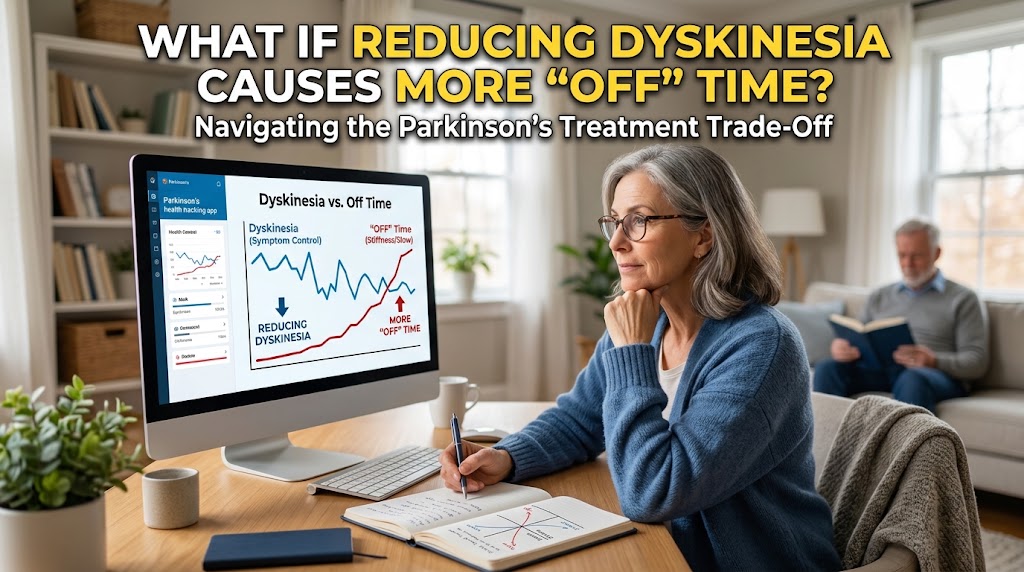
What If Reducing Dyskinesia Causes More “Off” Time?
Click Here To Watch Video to Treat Parkinson’s Disease Naturally!..
This is an important treatment challenge.
Reducing medication too aggressively may decrease dyskinesia but cause Parkinson’s symptoms to return.
The person may become slower, stiffer, or less mobile.
Therefore, the goal is not simply to eliminate dyskinesia at any cost. Instead, the goal is to find an appropriate balance between good mobility and manageable involuntary movements.
Advanced treatments may be considered when medication adjustments alone cannot achieve satisfactory control.
Frequently Asked Questions
Can reducing levodopa stop dyskinesia?
Reducing or adjusting levodopa can reduce dyskinesia in some patients, but it may also increase “off” symptoms. Medication changes should therefore be individualized and supervised by a healthcare professional.
Does exercise reduce Parkinson’s dyskinesia?
Exercise is important for overall Parkinson’s management, but it is not a direct treatment for medication-induced dyskinesia. A physical therapist can help develop a safe exercise program.
Is amantadine effective for dyskinesia?
Amantadine can reduce dyskinesia in some people with Parkinson’s disease. Its suitability depends on the individual’s health, medications, kidney function, cognitive status, and potential side effects.
Can DBS reduce dyskinesia?
DBS can reduce dyskinesia and motor fluctuations in appropriately selected patients. It may also allow medication adjustments that further reduce involuntary movements.
Is dyskinesia a sign that Parkinson’s is getting worse?
Dyskinesia is often associated with Parkinson’s progression and long-term dopaminergic treatment, but its presence alone does not provide a simple measure of disease severity. A specialist should evaluate changes in symptoms and medication response.
Final Thoughts
Reducing dyskinesia in Parkinson’s disease requires an individualized treatment strategy. Because dyskinesia is often related to the interaction between Parkinson’s progression and dopaminergic medication, simply stopping or dramatically reducing medication is usually not the answer.
Treatment may include adjusting levodopa doses and timing, using extended-release formulations, adding medications such as amantadine, or considering advanced treatments such as continuous infusion therapy or DBS. Focused ultrasound may also be an option for selected patients and specific indications.
Keeping a detailed medication and symptom diary can help your healthcare team understand when dyskinesia occurs and how it relates to treatment.
Most importantly, never change Parkinson’s medication on your own. Work with a movement-disorders specialist to find the best balance between controlling Parkinson’s symptoms, reducing “off” time, and minimizing dyskinesia.