
Parkinson’s disease can affect much more than walking, balance, and movement. As the condition progresses, some people develop changes in their voice, speech, facial expression, and swallowing. Speech may become quieter, less clear, or more monotone, making conversations increasingly difficult.
The good news is that speech-language therapy can help many people with Parkinson’s disease maintain communication and address swallowing difficulties. A speech-language pathologist (SLP), sometimes called a speech therapist, can evaluate specific problems and create an individualized treatment program.
This guide explains the best speech therapy approaches for Parkinson’s disease, including voice exercises, speech strategies, swallowing therapy, and communication techniques.
How Does Parkinson’s Disease Affect Speech?

Click Here To Watch Video to Treat Parkinson’s Disease Naturally!..
Parkinson’s disease affects the brain circuits that control movement. Because speaking involves coordinated movements of the respiratory system, vocal cords, tongue, lips, jaw, and facial muscles, Parkinson’s-related movement changes can affect communication.
Common speech and voice changes include:
- Speaking more quietly
- Reduced vocal intensity
- Monotone or less expressive speech
- Slurred or unclear words
- Speaking too quickly
- Mumbling
- Difficulty starting speech
- Reduced articulation
- Changes in breathing while speaking
- Difficulty controlling pitch and volume
A person may feel that they are speaking at a normal volume even when listeners have difficulty hearing them. This can happen because Parkinson’s can affect how people perceive and regulate the size or force of their movements.
Speech therapy focuses on helping patients become more aware of these changes and use specific strategies to improve communication.
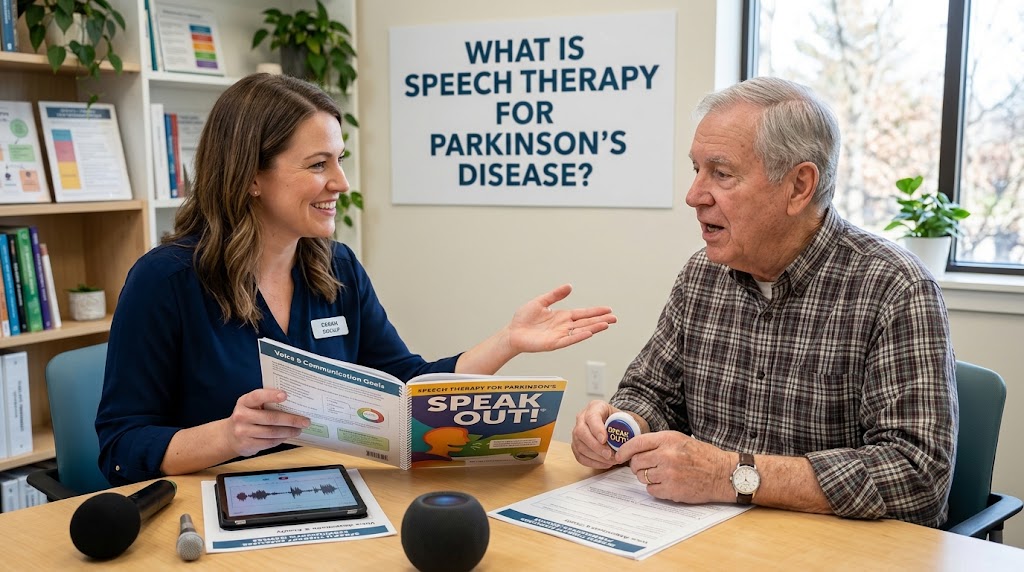
What Is Speech Therapy for Parkinson’s Disease?
Click Here To Watch Video to Treat Parkinson’s Disease Naturally!..
Speech therapy for Parkinson’s is provided by a qualified speech-language pathologist.
An SLP can assess:
- Voice volume
- Speech clarity
- Articulation
- Speaking rate
- Breath support
- Facial movement
- Communication effectiveness
- Cognitive-communication abilities
- Swallowing function
The therapist then develops a program based on the individual’s symptoms and communication goals.
For some people, therapy focuses mainly on voice and speech. For others, swallowing safety may be the primary concern.
1. Voice Therapy
One of the most common speech problems associated with Parkinson’s is hypophonia, or abnormally soft speech.
A person may speak so quietly that family members frequently ask them to repeat themselves.
Voice therapy can focus on increasing vocal loudness while maintaining natural speech quality.
Therapy may include:
- Sustained vowel exercises
- Controlled breathing
- Vocal intensity practice
- Reading aloud
- Conversation practice
- Pitch exercises
- Functional communication activities
The goal is not necessarily to make someone speak loudly all the time. Instead, therapy helps patients develop better awareness and control of their vocal intensity.
2. Lee Silverman Voice Treatment (LSVT LOUD)
LSVT LOUD is one of the best-known specialized speech therapy programs for people with Parkinson’s disease.
The program focuses primarily on increasing vocal loudness and improving awareness of voice intensity.
Patients practice structured vocal exercises and gradually apply the techniques to words, sentences, reading, and everyday conversation.
A key concept is helping the patient recognize what an appropriately strong voice feels like.
This can be important because someone with Parkinson’s may perceive a louder voice as excessively loud even when it is actually at an appropriate conversational level.
LSVT LOUD is typically delivered by a speech-language pathologist who has appropriate training in the program.
3. SPEAK OUT! and Other Parkinson’s Voice Programs
Another approach is SPEAK OUT!, a structured therapy program designed for people with Parkinson’s and related movement disorders.
The program emphasizes speaking with intention and practicing speech during structured exercises and everyday communication.
Other speech therapy approaches may also be used depending on the patient’s needs.
There is no single program that is automatically best for everyone. An SLP can determine which techniques are appropriate based on speech symptoms, cognition, hearing, motivation, and communication goals.
4. Articulation Therapy
Parkinson’s can make speech less precise.
Changes in movement control may affect the tongue, lips, jaw, and other structures needed to form clear sounds.
Articulation therapy focuses on producing speech sounds more deliberately.
Exercises may involve:
- Clear pronunciation of individual sounds
- Repeating words
- Practicing phrases
- Reading sentences
- Conversational speech
- Emphasizing consonants
Patients may learn to deliberately pronounce words more clearly rather than allowing speech to become rushed or reduced.
5. Speech Rate Control
Some people with Parkinson’s develop a faster speaking rate.
When speech becomes too rapid, sounds and words may blend together, making communication difficult.
Speech therapy may introduce strategies for slowing speech to a more understandable rate.
Techniques can include:
- Pausing between phrases
- Taking adequate breaths
- Using rhythmic cues
- Practicing deliberate articulation
- Breaking long sentences into shorter phrases
The goal is not necessarily slow speech. Instead, the objective is a rate that allows listeners to understand the speaker comfortably.
6. Breathing and Breath Support
Effective speech requires coordinated breathing.
Parkinson’s-related changes in posture, respiratory control, and muscle movement can affect how much air is available for speaking.
An SLP may teach breathing strategies that help patients coordinate respiration with speech.
Exercises may focus on:
- Taking appropriate breaths before speaking
- Speaking on an adequate breath
- Avoiding running out of air mid-sentence
- Coordinating breathing with longer phrases
- Improving respiratory awareness
Better breath support can contribute to stronger and more consistent speech.
7. Facial Exercise and Communication
Parkinson’s can reduce spontaneous facial movement, sometimes resulting in a less expressive face.
This may affect how emotions are communicated during conversations.
Speech therapy may incorporate facial movement exercises and strategies for increasing facial expression when appropriate.
However, facial exercises should be individualized because not every patient will benefit from the same techniques.
An occupational therapist may also help with facial and functional movement strategies when appropriate.
8. Swallowing Therapy
Speech-language pathologists do more than treat communication problems.
They also play an important role in evaluating and treating swallowing difficulties, known as dysphagia.
Parkinson’s can affect the muscles and coordination required for safe swallowing.
Possible warning signs include:
- Coughing during meals
- Choking
- Throat clearing while eating
- Food remaining in the mouth
- Difficulty swallowing pills
- Drooling
- A wet or gurgly voice after swallowing
- Unexplained weight loss
- Taking unusually long to finish meals
Swallowing problems should be taken seriously because they can increase the risk of aspiration and other complications.
9. Swallowing Exercises
If an evaluation identifies swallowing problems, the speech-language pathologist may recommend specific exercises or swallowing strategies.
Depending on the individual’s difficulty, therapy may focus on:
- Tongue movement
- Oral muscle coordination
- Swallow timing
- Strengthening specific swallowing muscles
- Posture during meals
- Safe swallowing techniques
The exact exercises depend on the type of swallowing impairment.
Patients should not begin specialized swallowing exercises without professional guidance because an inappropriate technique may not address the actual problem.
10. Eating and Drinking Strategies
An SLP may recommend changes to how food and liquids are consumed.
Strategies may include:
- Taking smaller bites
- Eating slowly
- Taking smaller sips
- Reducing distractions while eating
- Sitting upright
- Allowing enough time for each swallow
- Following specific swallowing instructions
In some cases, a healthcare professional may recommend changes to food texture or liquid consistency.
These recommendations should be individualized following a swallowing assessment.
11. Cognitive-Communication Therapy
Parkinson’s disease can sometimes affect attention, memory, executive function, or the ability to organize information.
These changes can make conversations and everyday communication more difficult.
Speech-language therapy may include cognitive-communication strategies such as:
- Memory aids
- Note-taking systems
- Planning strategies
- Attention exercises
- Conversation organization
- Problem-solving activities
Not everyone with Parkinson’s experiences significant cognitive changes, so therapy should be tailored to the individual’s needs.
12. Communication Strategies for Daily Life
Speech therapy should extend beyond exercises performed in a clinic.
Patients can practice communication strategies during everyday activities.
Helpful techniques may include:
Face the Listener
Making sure the listener can see your face can make communication easier.
Reduce Background Noise
Turning off the television or moving to a quieter environment can improve understanding.
Speak With Intention
Consciously focusing on speaking clearly and at an appropriate volume can help.
Pause Between Thoughts
Short pauses can make speech easier to understand.
Ask for Confirmation
If communication breaks down, asking the listener to confirm what they heard can prevent misunderstandings.
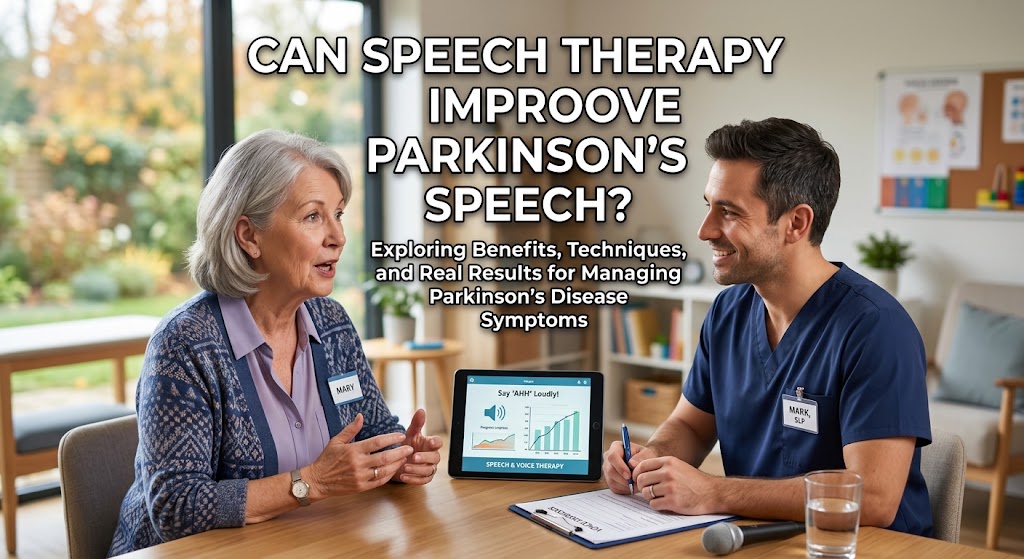
Can Speech Therapy Improve Parkinson’s Speech?
Click Here To Watch Video to Treat Parkinson’s Disease Naturally!..
Speech therapy can improve communication skills and help patients develop strategies for managing speech and voice changes.
The amount of improvement varies depending on factors such as:
- Severity of Parkinson’s disease
- Type of speech problem
- Hearing ability
- Cognitive function
- Consistency with practice
- Timing of treatment
- Individual response to therapy
Speech therapy does not cure Parkinson’s disease, but regular practice may help maintain communication abilities and improve confidence.
When Should Speech Therapy Begin?
People do not necessarily need to wait until speech problems become severe.
Early evaluation can help identify subtle changes in voice volume, articulation, or speaking rate.
Speech therapy may be particularly appropriate when someone notices:
- Family members frequently ask them to repeat themselves
- Their voice has become quieter
- Speech is becoming less clear
- They speak too quickly
- They have difficulty being heard in groups
- They experience coughing during meals
- Swallowing pills has become difficult
Early attention to communication and swallowing concerns can help patients develop useful strategies before problems become more disruptive.
How Often Should Speech Therapy Be Done?

Click Here To Watch Video to Treat Parkinson’s Disease Naturally!..
The frequency and duration of speech therapy depend on the treatment program and individual needs.
Some specialized programs use intensive therapy over several weeks, while other patients may require ongoing or periodic therapy.
Home practice is often an important component.
Consistency matters because patients need to practice communication strategies repeatedly to help incorporate them into everyday speech.
The SLP can recommend an appropriate schedule based on the person’s symptoms and goals.
Speech Therapy and Parkinson’s Medication

Click Here To Watch Video to Treat Parkinson’s Disease Naturally!..
Medication and speech therapy can work together.
Parkinson’s medications may improve certain motor symptoms, but they do not necessarily correct all speech or swallowing difficulties.
Some people find that speech is easier during medication “on” periods. Others may experience persistent speech problems despite good control of limb movement.
Patients should tell their SLP when they take Parkinson’s medication and when they experience their best and worst mobility.
This information can help the therapist understand how symptoms fluctuate throughout the day.
Tips for Practicing Speech at Home
Home practice can reinforce techniques learned during therapy.
Depending on your therapist’s recommendations, you may:
- Practice speaking at an appropriate volume
- Read aloud
- Record your voice and listen to it
- Practice clear articulation
- Use intentional speech
- Practice pausing between phrases
- Have short conversations with family members
- Reduce background noise during conversations
The specific exercises should come from your speech-language pathologist.
How Caregivers Can Help
Family members and caregivers can play an important role in communication.
Helpful strategies include:
- Give the person enough time to finish speaking.
- Avoid interrupting.
- Reduce background noise.
- Maintain eye contact.
- Ask for clarification respectfully.
- Encourage the person to use their speech strategies.
- Avoid shouting automatically when speech is difficult to understand.
- Be patient during conversations.
Communication should remain a two-way process. The goal is to support independence rather than speak for the person whenever communication becomes challenging.
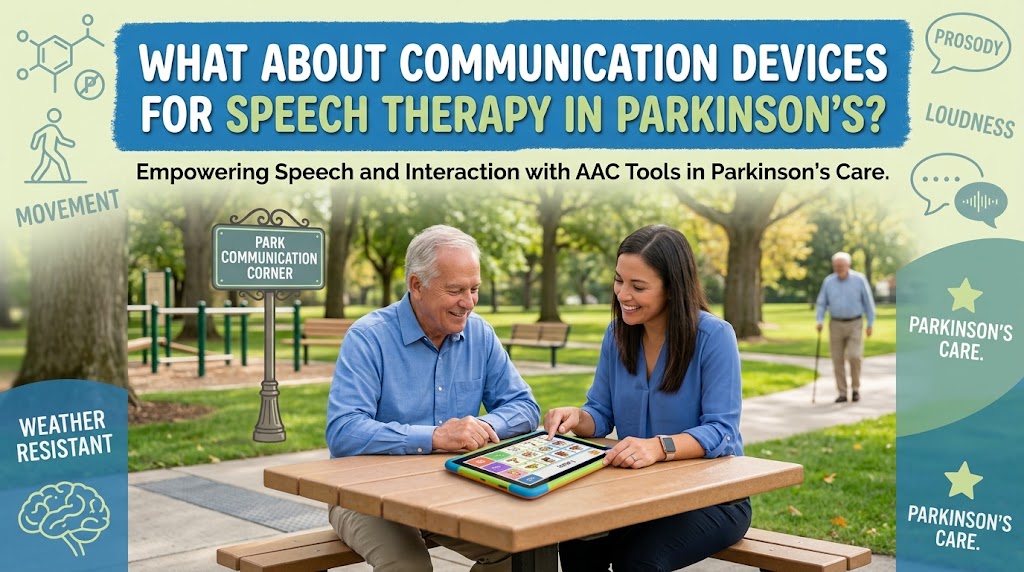
What About Communication Devices?
Click Here To Watch Video to Treat Parkinson’s Disease Naturally!..
Technology can provide additional support when speech becomes significantly impaired.
Options may include:
- Voice amplification systems
- Smartphone communication applications
- Text-to-speech devices
- Speech-generating devices
- Tablet-based communication tools
An SLP can help determine whether an augmentative and alternative communication (AAC) system may be useful.
Using a communication device does not mean someone has failed at speech therapy. Instead, it can provide an additional way to communicate when speaking becomes difficult.
Frequently Asked Questions
What is the best speech therapy for Parkinson’s disease?
There is no single therapy that is best for everyone. Specialized programs such as LSVT LOUD and SPEAK OUT! may benefit some people, while others may need individualized voice, articulation, rate-control, cognitive-communication, or swallowing therapy.
Can speech therapy restore normal speech?
Speech therapy may improve vocal loudness, clarity, communication strategies, and functional speech, but results vary. Parkinson’s is progressive, so therapy focuses on managing symptoms and maintaining communication rather than curing the disease.
Does LSVT LOUD help Parkinson’s?
LSVT LOUD is specifically designed to address voice and speech difficulties associated with Parkinson’s and can help some patients improve vocal loudness and communication.
Can speech therapy help swallowing?
Yes. Speech-language pathologists are trained to evaluate and treat swallowing disorders. They can recommend individualized exercises, swallowing strategies, and dietary modifications when appropriate.
Can speech therapy help with drooling?
Speech and swallowing therapy may help some people address factors contributing to drooling, particularly when reduced swallowing frequency or oral-motor difficulties are involved. Other medical treatments may also be considered.
Final Thoughts
Speech therapy is an important part of comprehensive Parkinson’s disease care. It can address quiet speech, unclear articulation, rapid speaking, reduced facial expression, swallowing difficulties, and cognitive-communication challenges.
Specialized approaches such as LSVT LOUD and SPEAK OUT! may be appropriate for some patients, while others may benefit from individualized voice, articulation, breathing, swallowing, or communication therapy.
The best approach depends on the individual’s symptoms and goals.
If you or someone you care for has noticed a quieter voice, increasing difficulty being understood, coughing during meals, or problems swallowing, consider asking a healthcare provider for a referral to a speech-language pathologist experienced in Parkinson’s disease.
With appropriate evaluation, regular practice, and ongoing support, speech therapy can help people with Parkinson’s maintain communication, improve swallowing safety, and remain more engaged in everyday life.