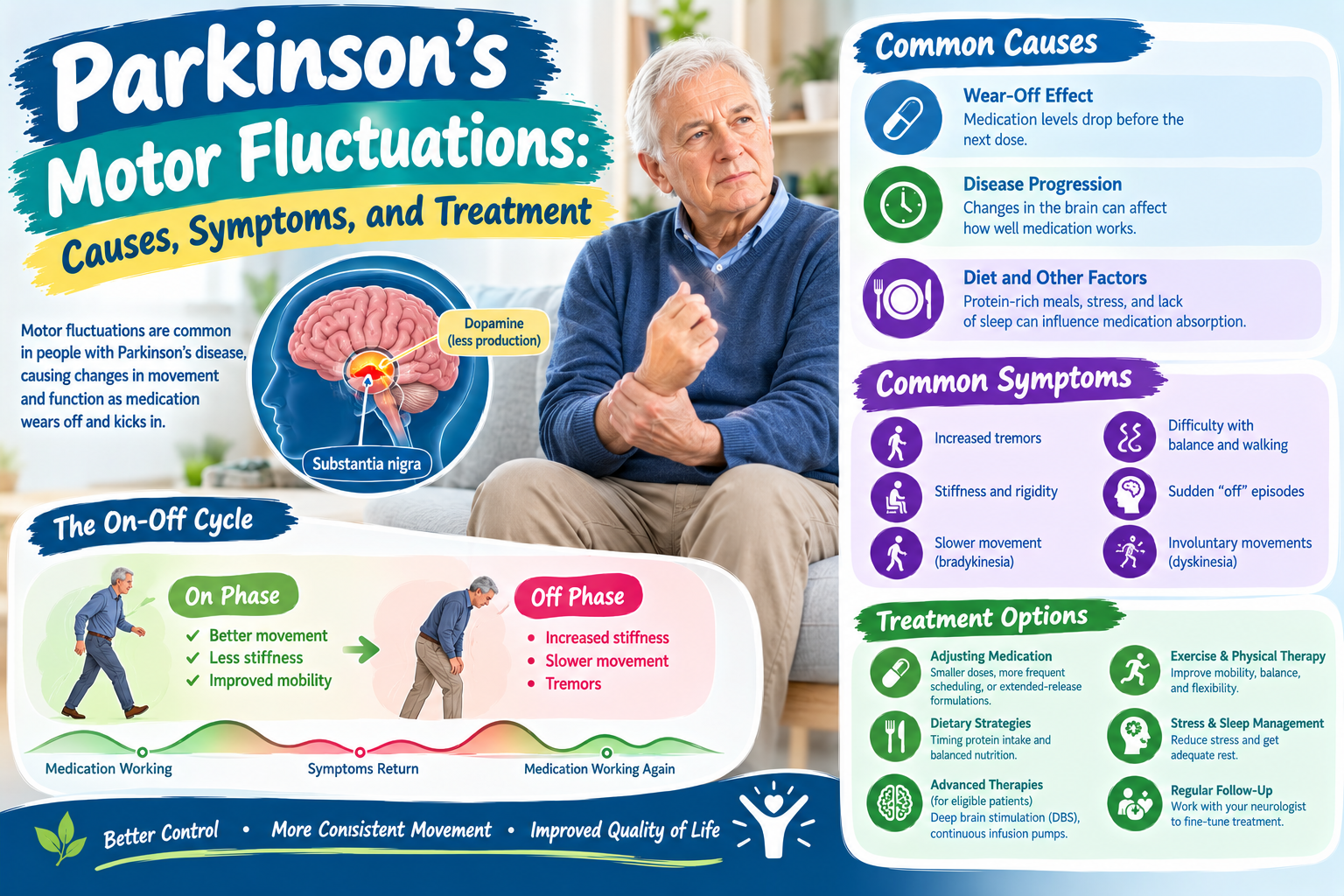
Parkinson’s disease is a progressive neurological condition that affects movement, coordination, and several non-movement functions. As Parkinson’s disease progresses, some people begin to experience motor fluctuations, meaning their ability to move can change throughout the day depending on when Parkinson’s medication is working.
A person may feel relatively mobile and comfortable during an “on” period, then experience stiffness, slowness, tremor, freezing, or difficulty moving when medication begins to wear off. These changes are sometimes called “on-off” fluctuations or “wearing off.”
Motor fluctuations can be frustrating, but they do not mean that treatment has stopped working. Medication schedules and other therapies can often be adjusted to improve symptom control and reduce time spent in the “off” state.
What Are Parkinson’s Motor Fluctuations?

Click Here To Watch Video to Treat Parkinson’s Disease Naturally!..
Motor fluctuations are changes in movement symptoms that occur throughout the day.
During an “on” period, Parkinson’s medication is providing effective symptom control. A person may walk more easily, experience less stiffness, and perform everyday activities more comfortably.
During an “off” period, the medication’s effect decreases and Parkinson’s symptoms return or become more noticeable.
Some people experience a predictable pattern in which symptoms return before the next scheduled dose. This is commonly called wearing off.
Other people may experience sudden or unpredictable transitions between “on” and “off” states.
Motor fluctuations are particularly associated with levodopa treatment as Parkinson’s disease progresses. Levodopa remains the most effective medication for controlling many Parkinson’s movement symptoms, but its effects can become less consistent over time.
What Causes Motor Fluctuations?
Motor fluctuations are closely related to changes in the brain’s dopamine system and the way the body responds to Parkinson’s medications.
Parkinson’s disease involves progressive loss of dopamine-producing brain cells. Dopamine is an important chemical messenger involved in movement control.
In earlier stages of the disease, remaining brain cells may help store and regulate dopamine. As Parkinson’s progresses, the brain becomes less able to store dopamine consistently.
As a result, the effects of each levodopa dose may become shorter or more noticeable as medication levels rise and fall.
Other factors can also influence fluctuations, including:
- Medication timing
- Delayed stomach emptying
- Constipation
- Large meals
- High-protein meals
- Stress
- Poor sleep
- Infection or illness
- Changes in daily routine
Food and digestion can sometimes affect how quickly levodopa reaches the bloodstream and brain.
Common Symptoms of “Off” Periods
During an “off” period, Parkinson’s symptoms can become more noticeable.
Common movement-related symptoms include:
- Slower movement
- Increased stiffness
- Tremor returning or becoming stronger
- Shuffling steps
- Difficulty getting up from a chair
- Trouble initiating movement
- Freezing
- Muscle cramps
- Abnormal muscle contractions
- Reduced mobility
A person may feel as though their feet are temporarily “stuck” to the floor during freezing episodes.
“Off” periods can also involve non-movement symptoms. These may include:
- Anxiety
- Irritability
- Low mood
- Fatigue
- Brain fog
- Pain
- Restlessness
- Sweating
Recognizing these symptoms is important because some people initially assume that only tremor and stiffness count as medication “off” symptoms.
What Is “Wearing Off”?
“Wearing off” occurs when the benefit of a Parkinson’s medication begins to fade before the next dose is due.
For example, someone might take carbidopa-levodopa and experience good movement for part of the dosing interval. As the medication effect decreases, stiffness and slowness may gradually return.
The timing can be predictable, but it can also become less predictable as Parkinson’s progresses.
Keeping track of when symptoms appear relative to medication doses can help your neurologist recognize whether wearing off is occurring.
What Is Dyskinesia?
Click Here To Watch Video to Treat Parkinson’s Disease Naturally!..
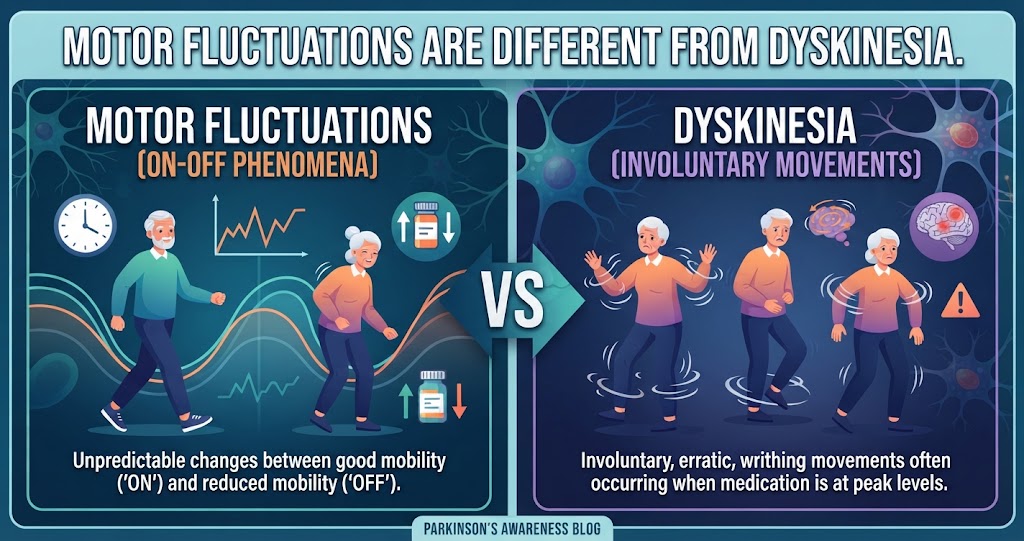
Motor fluctuations are different from dyskinesia.
Dyskinesia refers to involuntary, extra movements that can occur as a complication of Parkinson’s medication, particularly levodopa. They may appear when medication levels are relatively high, although different patterns can occur.
Dyskinesias may look like:
- Swaying
- Fidgeting
- Twisting
- Jerking
- Wiggling movements
- Repetitive movements
Some people experience dyskinesia during their best “on” periods, while others experience movements during transitions into or out of medication benefit.
It is important to tell your healthcare professional about both “off” symptoms and involuntary movements because the treatment strategy may be different.
How Are Motor Fluctuations Diagnosed?

Click Here To Watch Video to Treat Parkinson’s Disease Naturally!..
There is no single blood test that confirms motor fluctuations.
Diagnosis generally involves a detailed discussion about:
- Parkinson’s symptoms
- Medication schedule
- Timing of symptom changes
- Duration of medication benefit
- Involuntary movements
- Freezing episodes
- Activities affected by fluctuations
- Food and meal timing
- Sleep
- Other health problems
Keeping a symptom and medication diary can be extremely useful.
Record the time you take each medication and note when you experience:
- Good movement
- Stiffness
- Tremor
- Freezing
- Dyskinesia
- Pain
- Anxiety
- Fatigue
- Other noticeable symptoms
This can help your healthcare team identify patterns and determine whether medication adjustments may help.
Treatment for Parkinson’s Motor Fluctuations

Click Here To Watch Video to Treat Parkinson’s Disease Naturally!..
Treatment is individualized because Parkinson’s disease affects each person differently.
1. Adjusting Levodopa Timing
One of the first strategies may involve changing when doses are taken.
Your doctor may adjust the interval between doses or modify the amount taken at particular times of the day.
The objective is to provide more consistent symptom control while minimizing side effects.
Never change the dose or timing of levodopa on your own.
2. Using Extended-Release Medication
Some people may benefit from extended-release or controlled-release formulations designed to provide longer-lasting medication effects.
These formulations may be useful in selected situations, although the response varies between individuals.
Your neurologist can determine whether a different formulation is appropriate.
3. Adding Other Parkinson’s Medications
Other medications can sometimes be added to levodopa to extend its effects or improve symptom control.
These may include:
- MAO-B inhibitors
- COMT inhibitors
- Dopamine agonists
- Other medications selected according to individual symptoms
For example, MAO-B inhibitors can increase the availability of dopamine and may help reduce “off” time when used with other Parkinson’s medications.
Each medication has potential benefits and side effects, so treatment should be individualized.
4. Rescue Treatments for Sudden “Off” Episodes
Some people experience sudden or unpredictable “off” episodes.
In selected patients, healthcare professionals may prescribe fast-acting treatments intended to provide more rapid relief during an “off” episode.
Examples include inhaled levodopa and certain other rescue therapies. The appropriate option depends on medical history and existing medications.
5. Treating Dyskinesia
If involuntary movements become troublesome, the medication regimen may need adjustment.
In some situations, amantadine may be used to help reduce levodopa-induced dyskinesia. An extended-release formulation of amantadine is also approved specifically for levodopa-induced dyskinesia.
The goal is to balance good movement control with minimal involuntary movement.
6. Advanced Therapies
When medication adjustments no longer provide adequate control, a movement-disorder specialist may discuss advanced treatment options.
Depending on the individual, these may include:
- Deep brain stimulation
- Continuous medication infusion
- Intestinal levodopa infusion
- Subcutaneous levodopa infusion
- Focused ultrasound or other lesion-based procedures in selected cases
These treatments are not appropriate for everyone. A specialist evaluation is needed to determine eligibility and potential benefits and risks.
Exercise and Rehabilitation
Medication is only one part of Parkinson’s management.
Regular physical activity can help support strength, mobility, flexibility, balance, and independence.
Depending on individual abilities, an exercise program may include:
- Walking
- Strength training
- Stretching
- Balance exercises
- Cycling
- Dance
- Tai chi
- Physical therapy
Exercise should be adapted to the person’s symptoms and fall risk.
People experiencing frequent freezing or falls may benefit from working with a physical therapist who understands Parkinson’s disease.
Managing Motor Fluctuations at Home

Click Here To Watch Video to Treat Parkinson’s Disease Naturally!..
Several practical habits can make daily fluctuations easier to manage.
Take Medication on Schedule
Use alarms, phone reminders, pill organizers, or other systems to reduce missed doses.
Medication timing can be particularly important when “off” periods are predictable.
Track Your Symptoms
Write down medication times and symptom changes.
Look for patterns involving:
- Meals
- Exercise
- Stress
- Sleep
- Constipation
- Medication timing
Share this information with your healthcare team.
Plan Activities Around “On” Periods
If your medication produces predictable “on” periods, schedule important activities when movement is usually better.
For example, appointments, shopping, exercise, or social activities may be easier when medication is providing good symptom control.
Address Constipation and Digestion
Constipation and delayed digestion can interfere with medication absorption and may contribute to delayed or inconsistent medication effects.
Discuss persistent digestive problems with your healthcare professional rather than relying solely on home remedies.
When Should You Contact Your Doctor?
Talk with your neurologist if you notice:
- Medication wearing off earlier than expected
- Increasing “off” periods
- Sudden unpredictable freezing
- Increasing falls
- New or worsening dyskinesia
- Medication doses that no longer seem effective
- Symptoms returning before every dose
- Significant anxiety or mood changes related to medication timing
- Difficulty performing everyday activities
You do not need to wait until symptoms become severe before discussing fluctuations.
Early recognition can give your healthcare team more opportunities to adjust the treatment plan.
Final Thoughts
Parkinson’s motor fluctuations are changes between periods of better and poorer movement control, often related to the changing effects of Parkinson’s medications as the disease progresses.
“Off” periods can involve stiffness, slowness, tremor, freezing, cramps, pain, fatigue, anxiety, and other symptoms. Dyskinesia, meanwhile, refers to involuntary movements that can occur as a complication of dopaminergic treatment.
Treatment may involve adjusting levodopa timing or formulation, adding other medications, using rescue treatments, treating dyskinesia, introducing rehabilitation and exercise, or considering advanced therapies when appropriate.
The most important step is to communicate clearly with your neurologist or movement-disorder specialist. Keeping a medication and symptom diary can make these conversations much more useful.
With individualized treatment and regular monitoring, many people can reduce the impact of motor fluctuations and maintain greater mobility and independence.
Medical Disclaimer: This article is intended for general educational purposes and does not replace professional medical diagnosis, treatment, or advice. Parkinson’s medications can have significant side effects and interactions. Do not change, stop, or increase Parkinson’s medication without guidance from your neurologist or other qualified healthcare professional.