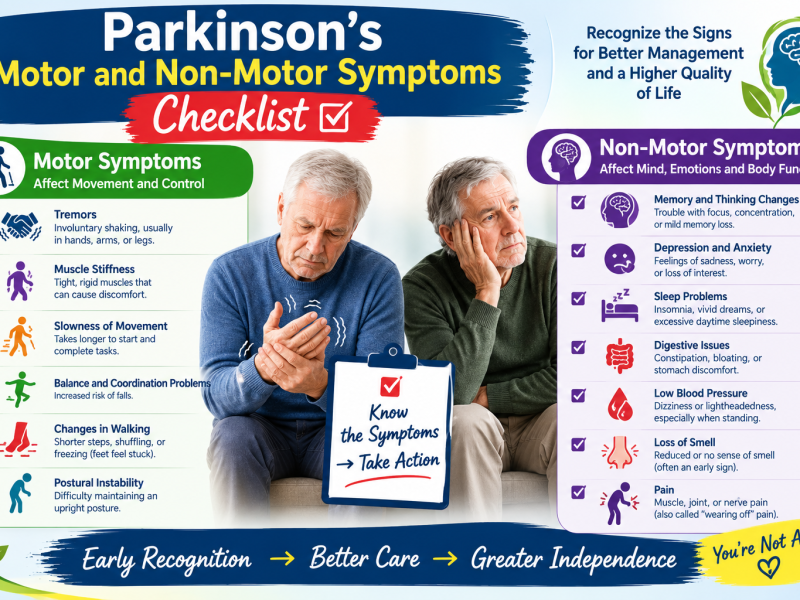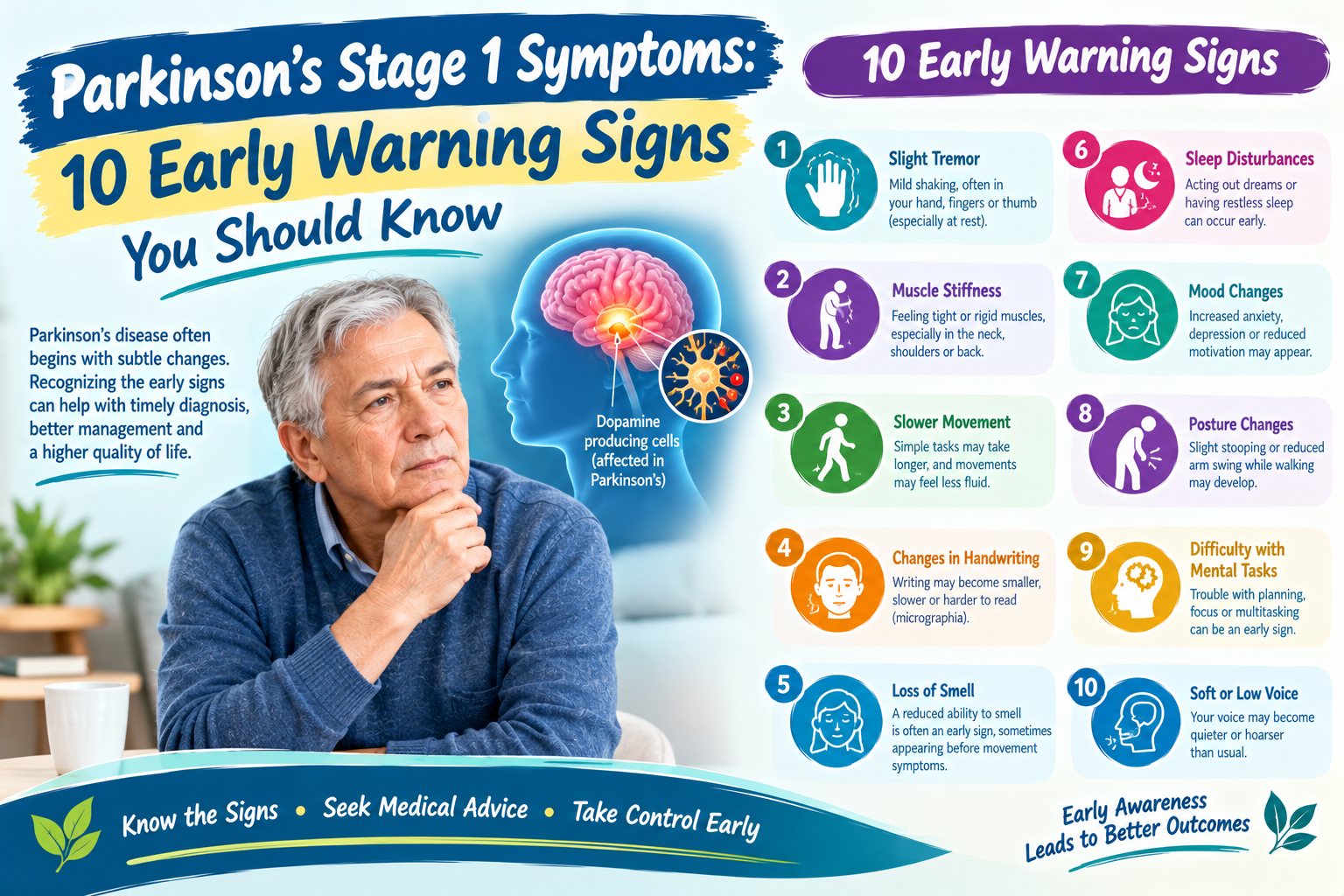
Parkinson’s disease is a progressive neurological disorder that primarily affects movement, but early symptoms can be subtle and easy to overlook. During stage 1 Parkinson’s disease, symptoms are generally mild and often affect only one side of the body. Many people can continue working, exercising, and performing daily activities independently.
Recognizing early changes can encourage timely medical evaluation. However, having one or more of these symptoms does not necessarily mean that a person has Parkinson’s disease. Several other conditions can cause similar symptoms.
Parkinson’s disease is typically diagnosed based on a person’s medical history and neurological examination rather than one single laboratory test.
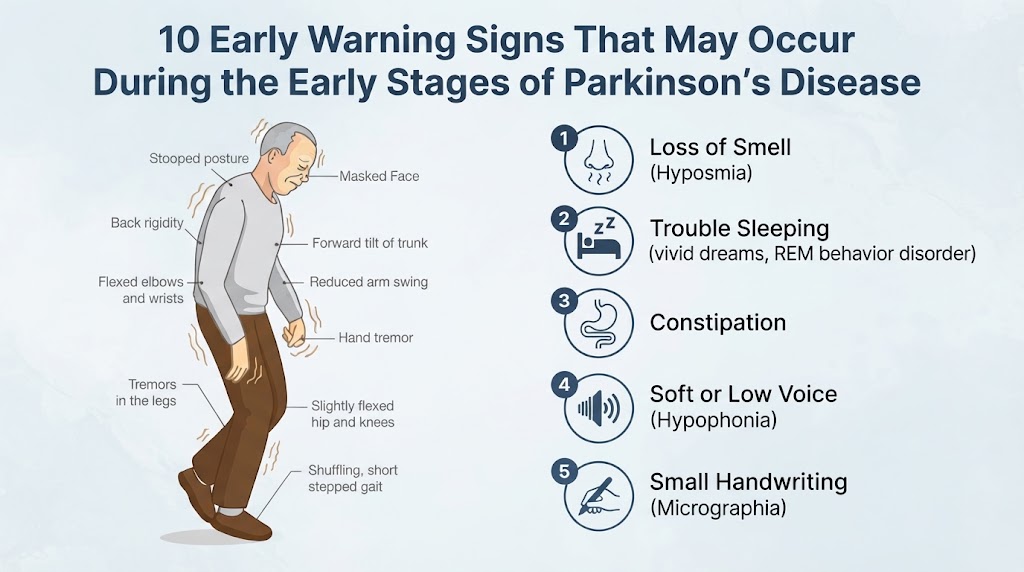
10 Early Warning Signs That May Occur During the Early Stages of Parkinson’s Disease.
Click Here To Watch Video to Treat Parkinson’s Disease Naturally!..
1. Tremor at Rest
One of the symptoms commonly associated with Parkinson’s disease is a resting tremor.
This may appear as a subtle shaking in:
- One hand
- Fingers
- Thumb
- Chin
- Jaw
- Foot
A Parkinson’s tremor often occurs when the affected body part is relaxed and may become less noticeable during purposeful movement.
Early tremor may begin on one side and remain relatively mild for some time.
However, not every tremor is caused by Parkinson’s disease. Essential tremor, medications, thyroid problems, anxiety, and other neurological conditions can also cause shaking.
A new or unexplained tremor should therefore be evaluated by a healthcare professional.
2. Slower Movement
Bradykinesia, or slowness of movement, is a major motor feature of Parkinson’s disease.
At first, the change may be so gradual that a person barely notices it.
You might find that:
- Getting dressed takes longer.
- Buttons are harder to fasten.
- Writing becomes slower.
- Walking speed decreases.
- Household tasks take more time.
- It becomes harder to perform repetitive movements.
Family members may notice the change before the person does.
Slowness can also affect facial expressions and gestures, making someone appear less expressive than usual.
Because many conditions can cause slowed movement, persistent or progressive changes should be discussed with a healthcare professional.
3. Muscle Stiffness
Another possible early symptom is rigidity, or muscle stiffness.
You may notice stiffness in:
- The shoulder
- Arm
- Neck
- Hip
- Leg
It may feel like a joint or muscle is tight even when there has been no obvious injury.
Sometimes stiffness is mistaken for arthritis, a muscle strain, or normal aging.
Parkinson’s-related rigidity can occur on one side of the body and may accompany slowness of movement.
If stiffness persists, particularly when it occurs together with tremor or movement changes, a neurological evaluation may be appropriate.
4. Changes in Walking
Changes in walking can develop early in Parkinson’s disease, although significant walking impairment is generally more characteristic of later stages.
Early changes may include:
- Walking more slowly
- Taking smaller steps
- Reduced arm swing on one side
- Feeling less steady
- Taking longer to turn
- A subtle change in posture
One arm may swing less naturally while walking.
A person may not immediately recognize this change, but family members or friends may notice that their walking pattern looks different.
If walking changes appear suddenly, however, urgent medical assessment may be necessary because sudden movement problems can have other causes.
5. Reduced Arm Swing
A reduced or absent arm swing on one side can be an early movement change.
Normally, the arms swing naturally in coordination with the legs when walking.
With Parkinson’s disease, one arm may gradually swing less than the other.
For example, you might notice that your right arm moves normally while your left arm remains closer to your body.
This sign is not diagnostic by itself. Shoulder problems, previous injuries, pain, and other neurological conditions can also reduce arm movement.
However, reduced arm swing combined with slowness, stiffness, or tremor may warrant further evaluation.
6. Changes in Handwriting
Parkinson’s disease can cause a handwriting change called micrographia, in which handwriting becomes unusually small or cramped.
You might notice that:
- Letters gradually become smaller.
- Words become crowded.
- Writing becomes slower.
- Your signature looks different.
- Handwriting becomes difficult to read.
Sometimes the change is more noticeable when writing longer sentences.
Handwriting changes can occur for many reasons, including arthritis, vision problems, weakness, or other neurological conditions.
However, a progressive change accompanied by other movement symptoms should be discussed with a healthcare professional.
7. Reduced Facial Expression
Parkinson’s disease can affect the muscles involved in facial expression.
Some people develop a less expressive face, sometimes called hypomimia.
Others may appear more serious or less animated even though they are experiencing their normal emotions.
This can happen because facial movements become slower or less frequent.
Friends or family members might comment that you look tired, serious, or less expressive than usual.
Reduced facial expression is not specific to Parkinson’s disease and can occur for other reasons, so it should be considered alongside other symptoms.
8. Changes in Voice
Speech and voice changes may also occur.
A person may notice:
- Speaking more quietly
- A softer voice
- Less variation in pitch
- Speech becoming less clear
- Words sounding rushed or less distinct
Sometimes family members notice that they have to ask the person to repeat themselves.
Voice changes can occur because Parkinson’s disease affects the muscles involved in speech and breathing.
However, many other conditions can affect the voice, including vocal-cord disorders, respiratory problems, and other neurological conditions.
A speech-language professional can evaluate persistent speech or voice changes.
9. Changes in Posture and Balance
Early Parkinson’s disease may be associated with subtle posture changes.
Someone may gradually begin to:
- Lean slightly forward
- Hold their shoulders differently
- Walk with a more rigid posture
- Have difficulty maintaining an upright position
Significant balance problems and frequent falls are more commonly associated with later stages of Parkinson’s disease. If severe balance problems appear very early, doctors may consider other possible diagnoses as well.
Balance changes should always be taken seriously because falls can cause significant injuries.
Strengthening exercises, physical therapy, and appropriate balance training may help maintain mobility.
10. Reduced Ability to Perform Automatic Movements
Parkinson’s disease can reduce the speed or frequency of automatic movements.
Examples include:
- Blinking less frequently
- Reduced facial movements
- Less arm movement while walking
- Fewer spontaneous gestures
- Difficulty performing repetitive movements
These changes may be subtle and develop gradually.
A person may not notice them until someone else points them out.
When these changes occur together with other Parkinson’s symptoms, a neurological assessment can help determine the possible cause.
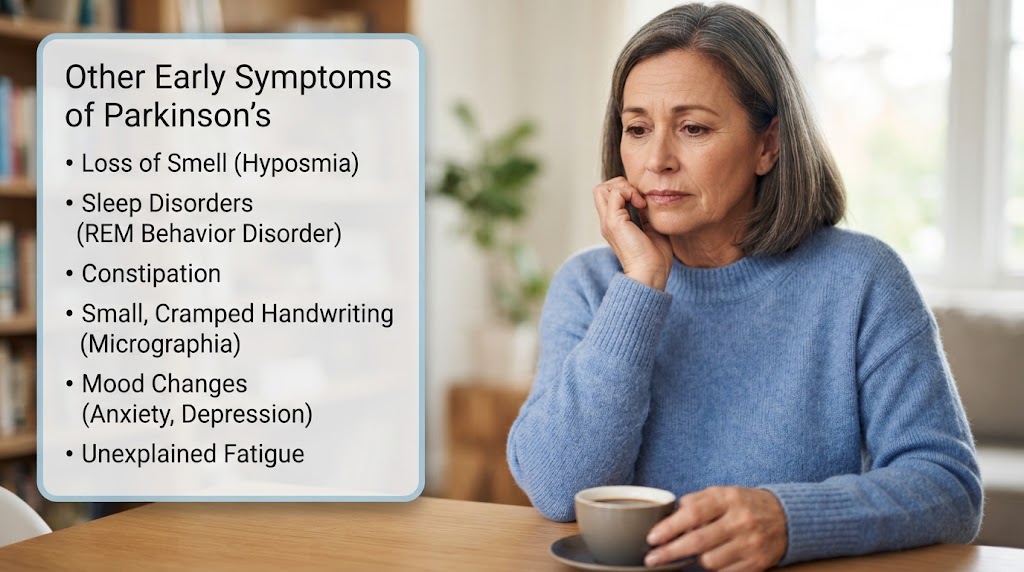
Other Early Symptoms to Know About
Click Here To Watch Video to Treat Parkinson’s Disease Naturally!..
Parkinson’s disease can also cause symptoms that are not directly related to movement.
Some people experience non-motor symptoms before or around the time of motor symptoms.
These can include:
Loss of Smell
A reduced ability to smell, called hyposmia, can occur in Parkinson’s disease.
However, loss of smell is also common with allergies, viral infections, nasal conditions, aging, and other illnesses.
Constipation
Constipation can occur as part of Parkinson’s disease and may sometimes appear before noticeable movement symptoms.
It is very common in the general population, so constipation alone does not mean someone has Parkinson’s disease.
Sleep Problems
Some people experience sleep-related changes, including acting out dreams during REM sleep.
Unusual movements or vocalizations during dreams should be discussed with a healthcare professional.
Depression or Anxiety
Mood changes can occur in Parkinson’s disease and may sometimes precede obvious movement symptoms.
However, depression and anxiety are extremely common and have many possible causes.
What Is Stage 1 Parkinson’s Disease?

Click Here To Watch Video to Treat Parkinson’s Disease Naturally!..
Parkinson’s disease is commonly described using the Hoehn and Yahr scale, which classifies motor disability into stages.
In stage 1, symptoms are generally mild and typically affect one side of the body. A person can usually perform daily activities independently.
Stage 2 involves symptoms affecting both sides of the body, although balance is generally maintained.
As Parkinson’s disease progresses to later stages, walking, balance, and independence can become increasingly affected.
It is important to remember that Parkinson’s disease does not progress at exactly the same rate in every person.
How Is Early Parkinson’s Disease Diagnosed?

Click Here To Watch Video to Treat Parkinson’s Disease Naturally!..
There is no single test that definitively diagnoses Parkinson’s disease in every case.
A neurologist may consider:
- Medical history
- Symptom pattern
- Neurological examination
- Medication history
- Family history
- Response to Parkinson’s medication
- Other tests when necessary
Imaging or laboratory tests may sometimes be used to rule out other conditions.
A specialist may also look for combinations of symptoms rather than relying on one isolated sign.
When Should You See a Doctor?
Consider arranging a medical evaluation if you develop persistent or progressively worsening symptoms such as:
- A new resting tremor
- Increasing movement slowness
- Unexplained muscle stiffness
- Changes in walking
- Reduced arm swing
- Progressive handwriting changes
- Speech or voice changes
- New balance problems
- Significant changes in facial expression
- Multiple symptoms occurring together
Early evaluation can help identify the cause of symptoms and determine whether treatment or monitoring is appropriate.
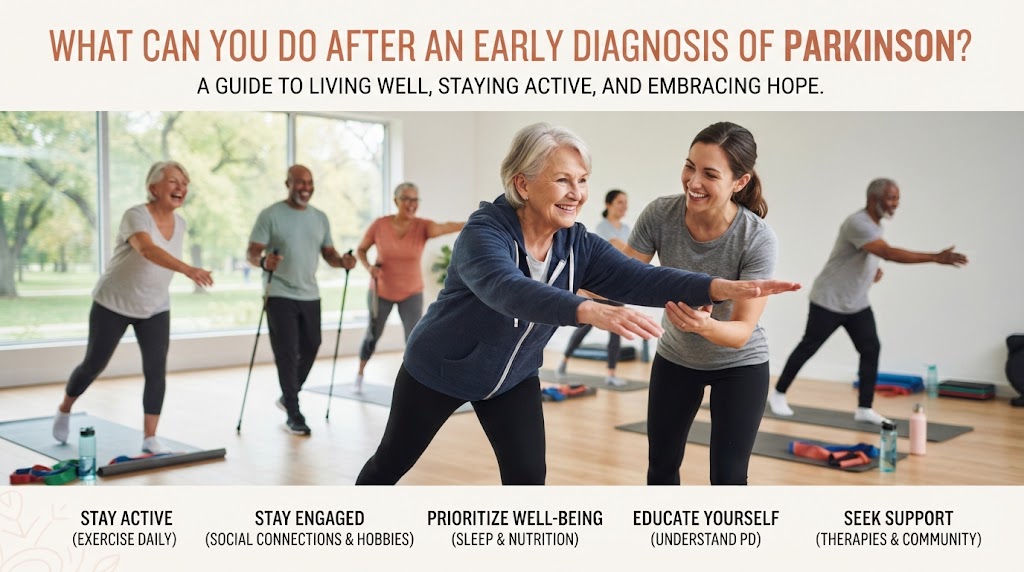
What Can You Do After an Early Diagnosis?
Click Here To Watch Video to Treat Parkinson’s Disease Naturally!..
If Parkinson’s disease is diagnosed, treatment is individualized.
Depending on symptoms and their impact on daily life, management may include:
- Regular physical activity
- Physical therapy
- Occupational therapy
- Speech therapy
- Medication
- Balance and fall-prevention strategies
- Nutrition and healthy lifestyle habits
- Regular neurological follow-up
Exercise can be an important component of Parkinson’s management. Walking, strength training, balance exercises, cycling, stretching, dancing, and other activities may be incorporated depending on an individual’s abilities and medical advice.
Final Thoughts
Stage 1 Parkinson’s disease can be difficult to recognize because symptoms are often mild and develop gradually. A resting tremor, slowed movement, stiffness, reduced arm swing, handwriting changes, reduced facial expression, softer speech, subtle walking changes, posture changes, and reduced automatic movements are among the signs that may occur.
Non-motor symptoms such as loss of smell, constipation, sleep problems, depression, or anxiety can also occur, although they have many other possible causes.
Having one symptom does not mean that you have Parkinson’s disease. The combination, progression, and pattern of symptoms are important.
If you notice persistent or progressively worsening movement changes, speak with a healthcare professional or neurologist. Early assessment can help determine the cause and provide an opportunity to discuss appropriate treatment, exercise, rehabilitation, and long-term management.
Medical Disclaimer: This article is intended for general educational purposes and does not replace professional medical diagnosis, treatment, or advice. Parkinson’s disease can resemble other neurological or medical conditions, so persistent or unexplained symptoms should be evaluated by a qualified healthcare professional.