
Parkinson’s disease is a progressive neurological condition that can make movement increasingly difficult. Symptoms such as tremor, stiffness, slowed movement, and motor fluctuations may become harder to control as the disease progresses. For many people, oral medications remain the foundation of treatment. However, as Parkinson’s advances, some patients experience periods when medications do not last long enough or when controlling symptoms becomes more complicated.
This is where infusion therapy for Parkinson’s disease may have a role.
Infusion-based treatments can provide medication continuously or at carefully controlled rates, helping reduce some of the fluctuations that occur with intermittent oral dosing. Depending on the therapy, infusion treatment may deliver medication through a pump, a feeding-tube-like system, or an intravenous (IV) line.
In this guide, we’ll explain what infusion therapy is, how it works, who may benefit, potential advantages and risks, and what patients can expect.
What Is Infusion Therapy for Parkinson’s Disease?

Click Here To Watch Video to Treat Parkinson’s Disease Naturally!..
Infusion therapy refers to delivering medication continuously or at regular controlled intervals instead of relying entirely on tablets taken throughout the day.
The goal is often to provide a more consistent level of medication and reduce the changes between medication “on” and “off” periods.
Some advanced Parkinson’s treatments use continuous delivery of dopaminergic medications. These therapies are generally considered when symptoms are no longer adequately controlled with conventional oral medications or when patients experience significant motor fluctuations.
Infusion therapy does not cure Parkinson’s disease or stop the underlying loss of dopamine-producing nerve cells. Instead, it is intended to improve symptom control and help patients maintain more predictable movement throughout the day.
Why Do Parkinson’s Symptoms Fluctuate?

Click Here To Watch Video to Treat Parkinson’s Disease Naturally!..
To understand why infusion therapy may help, it is useful to understand what happens with conventional medication treatment.
Levodopa is one of the most effective medications for improving Parkinson’s motor symptoms. It is converted into dopamine in the brain and can improve movement, stiffness, and other symptoms.
However, as Parkinson’s progresses, the brain becomes less capable of storing and buffering dopamine. As a result, the effects of each medication dose can become more dependent on the timing of the dose and how consistently medication reaches the brain.
Some patients begin experiencing motor fluctuations.
For example, a person may feel relatively mobile shortly after taking medication but notice symptoms returning before the next dose.
This can create a cycle of:
Medication → improved movement → medication wearing off → worsening symptoms → next medication dose
Infusion therapy aims to make medication delivery more continuous and predictable.
What Are “On” and “Off” Periods?
An “on” period is a time when Parkinson’s medication is providing good symptom control and the person can move more comfortably.
An “off” period occurs when medication benefits decrease and Parkinson’s symptoms return or become significantly worse.
Off periods can involve:
- Slowness
- Tremor
- Muscle stiffness
- Difficulty walking
- Trouble getting up from a chair
- Difficulty starting movements
Some people experience predictable wearing-off before their next medication dose, while others may have unpredictable fluctuations.
Reducing these fluctuations is one of the major goals of advanced Parkinson’s treatment.
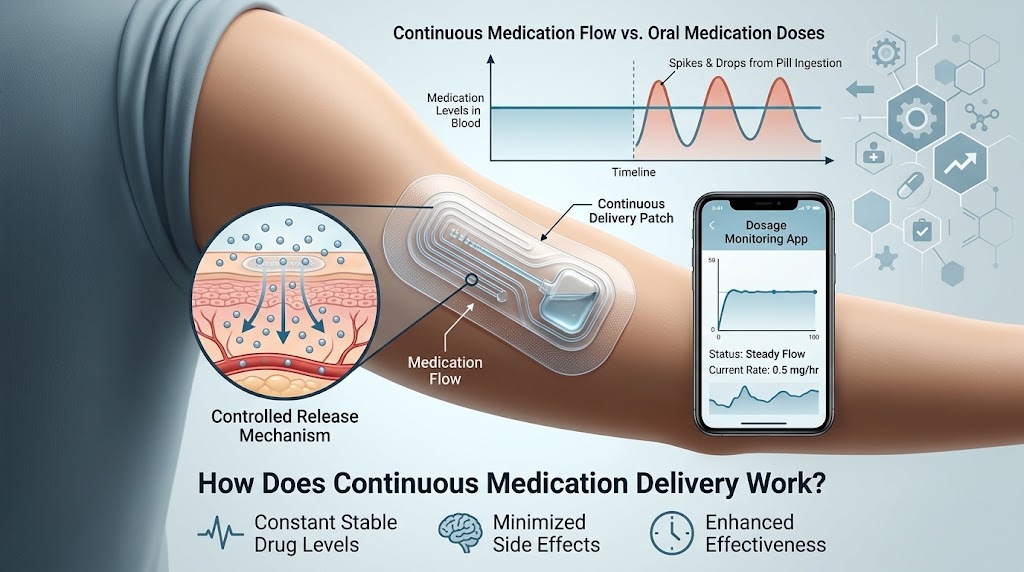
How Does Continuous Medication Delivery Work?
Click Here To Watch Video to Treat Parkinson’s Disease Naturally!..
Infusion therapy changes the way medication reaches the body.
Instead of taking medication periodically, a pump or infusion system can provide medication continuously or according to a programmed schedule.
The exact mechanism depends on the specific treatment.
For example, some infusion systems deliver a levodopa-based medication directly into the small intestine through a specialized tube. Other treatments may deliver medication through a subcutaneous infusion system, meaning medication is delivered under the skin.
The purpose is similar: maintain a more consistent medication exposure and reduce the peaks and valleys associated with intermittent dosing.
Types of Infusion Therapy Used in Parkinson’s Disease
Several advanced infusion approaches have been developed or studied for Parkinson’s disease.
Levodopa-Based Intestinal Infusion
One approach uses a levodopa-based gel or suspension delivered continuously into the small intestine through a specialized enteral delivery system.
The medication bypasses some of the variability associated with stomach emptying and provides continuous delivery.
This approach may be considered for people with advanced Parkinson’s disease who experience significant motor fluctuations despite optimized oral treatment.
Subcutaneous Infusion
Another approach delivers medication continuously beneath the skin through a small infusion system.
Depending on the medication and country or regulatory approval, different therapies may be available.
Subcutaneous infusion can provide continuous dopaminergic stimulation without requiring repeated oral doses throughout the day.
The suitability of a particular treatment depends on the patient’s symptoms, previous medication response, medical history, and availability of the therapy.
Intravenous Infusion
IV infusions may also be used in some Parkinson’s-related circumstances, but they are different from the continuous dopaminergic infusion approaches generally discussed as advanced Parkinson’s treatments.
IV therapy may be used for specific medical situations rather than as a routine long-term replacement for oral Parkinson’s medication.
Patients should therefore distinguish between long-term continuous infusion therapies and temporary IV treatment provided in a hospital or clinical setting.
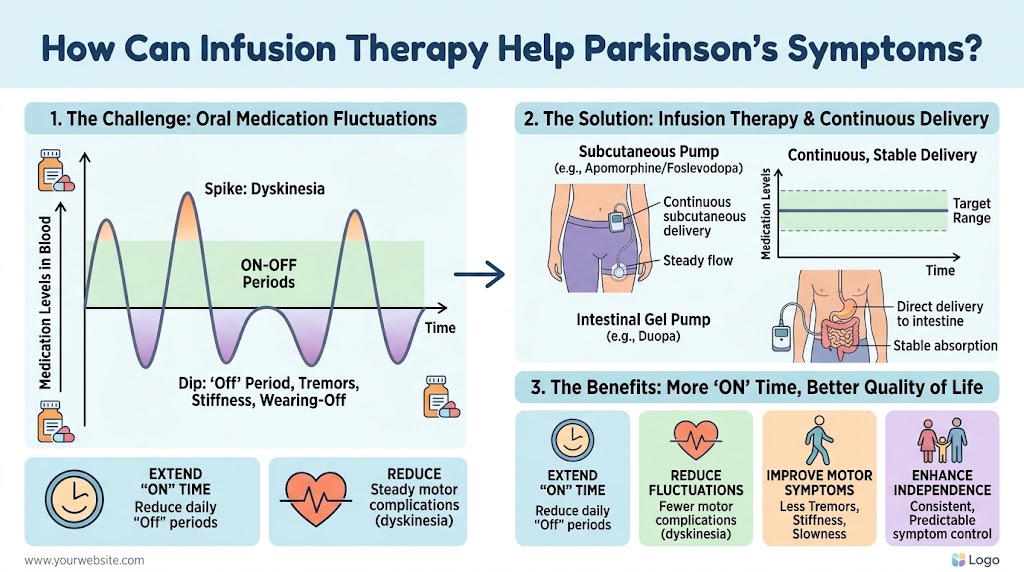
How Can Infusion Therapy Help Parkinson’s Symptoms?
Click Here To Watch Video to Treat Parkinson’s Disease Naturally!..
The primary benefit of continuous dopaminergic infusion is improved control of motor symptoms in appropriately selected patients.
1. May Reduce “Off” Time
One of the most important potential benefits is reducing the amount of time a patient spends in an “off” state.
Continuous medication delivery can help maintain medication effects for longer periods and reduce fluctuations.
This may allow patients to spend more of the day in a functional “on” state.
2. May Improve Motor Fluctuations
Infusion therapy is designed to smooth medication delivery.
Instead of experiencing pronounced changes after individual doses, continuous delivery may produce steadier symptom control.
This can be particularly helpful for patients whose symptoms fluctuate substantially during the day.
3. May Improve Mobility
When motor symptoms are better controlled, patients may find everyday activities easier.
Depending on the individual, improved control may help with:
- Walking
- Dressing
- Eating
- Household activities
- Getting out of bed
- Getting up from a chair
- Participating in social activities
The degree of improvement varies from person to person.
4. May Reduce Certain Dyskinesias
Some people develop dyskinesia, which refers to involuntary, often twisting or flowing movements associated with long-term dopaminergic treatment.
Because infusion therapy can provide a more consistent medication effect, it may reduce fluctuations that contribute to certain forms of dyskinesia.
However, dyskinesia is complex, and infusion therapy does not necessarily eliminate it completely.
5. May Provide More Predictable Days
For some patients, unpredictability is one of the most difficult aspects of advanced Parkinson’s disease.
A person may not know whether medication will work, when it will wear off, or whether they will be able to walk comfortably at a particular time.
More continuous medication delivery may make symptom control more predictable.
That predictability can be valuable when planning daily activities, appointments, exercise, or social events.
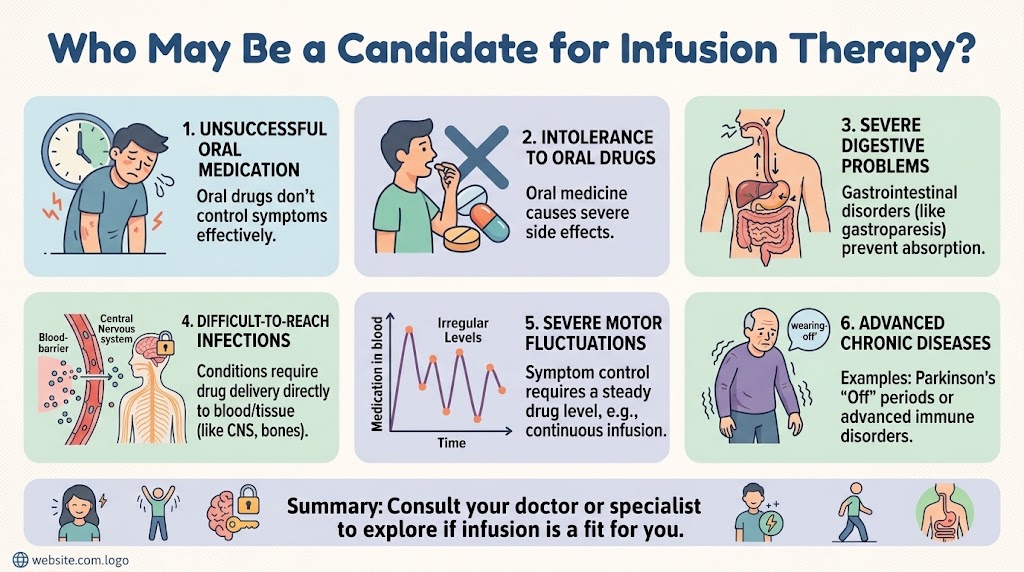
Who May Be a Candidate for Infusion Therapy?
Click Here To Watch Video to Treat Parkinson’s Disease Naturally!..
Infusion therapy is generally considered for selected people with advanced Parkinson’s disease who continue to experience significant motor complications despite optimized medication treatment.
A specialist may consider infusion therapy when a patient has:
- Frequent “off” periods
- Wearing-off between oral doses
- Significant motor fluctuations
- Troublesome dyskinesia
- A meaningful response to levodopa but inadequate duration of benefit
- Difficulty achieving consistent symptom control with oral medications
The decision is highly individualized.
Doctors also consider cognitive function, ability to manage the treatment system, caregiver support, other medical conditions, and the patient’s preferences.
What Happens Before Starting Infusion Therapy?
Before beginning treatment, a movement-disorders specialist usually performs a detailed evaluation.
This may include reviewing:
- Current Parkinson’s medications
- Medication timing
- “On” and “off” periods
- Dyskinesia
- Tremor and rigidity
- Walking ability
- Cognitive function
- Daily activities
- Other health conditions
Patients may be asked to keep a symptom or medication diary.
This can help the medical team understand when symptoms appear and how long each medication dose provides benefit.
The specialist can then determine whether an advanced treatment such as infusion therapy is appropriate.
What Is It Like to Use an Infusion Pump?
The experience depends on the specific therapy.
A pump is generally small enough to be worn or carried throughout the day. It delivers medication according to programmed settings.
Patients and caregivers receive training on:
- How to operate the pump
- How to start and stop the infusion
- How to manage the delivery system
- How to recognize potential problems
- How to maintain the equipment
- What to do if medication delivery is interrupted
The treatment may initially feel unfamiliar, but many patients become more comfortable with the system after receiving appropriate training.
What Are the Potential Risks and Side Effects?
Like any advanced treatment, infusion therapy has potential risks.
Side effects depend on the medication and delivery method.
Possible medication-related effects can include:
- Nausea
- Dizziness
- Sleepiness
- Confusion
- Hallucinations
- Low blood pressure
- Dyskinesia
Infusion systems can also have device- or administration-related complications.
For example, treatments delivered through a tube can have problems involving the tube or insertion site. Subcutaneous infusion can cause skin reactions, redness, swelling, or irritation at infusion sites.
Patients should report new or worsening symptoms to their healthcare team.
Infusion Therapy vs. Oral Medication
Oral medication remains an important treatment for many people with Parkinson’s disease.
The main difference is how medication is delivered.
Oral medications:
- Taken at scheduled times
- Convenient for many patients
- Can be effective for years
- May become less consistent as Parkinson’s progresses
Infusion therapy:
- Provides continuous or controlled medication delivery
- May reduce medication fluctuations
- Requires equipment or a delivery system
- Requires training and ongoing management
- May be considered when conventional medication is no longer providing adequate control
Infusion therapy is therefore not necessarily a replacement for all oral medication. A specialist may use it as part of a broader treatment strategy.
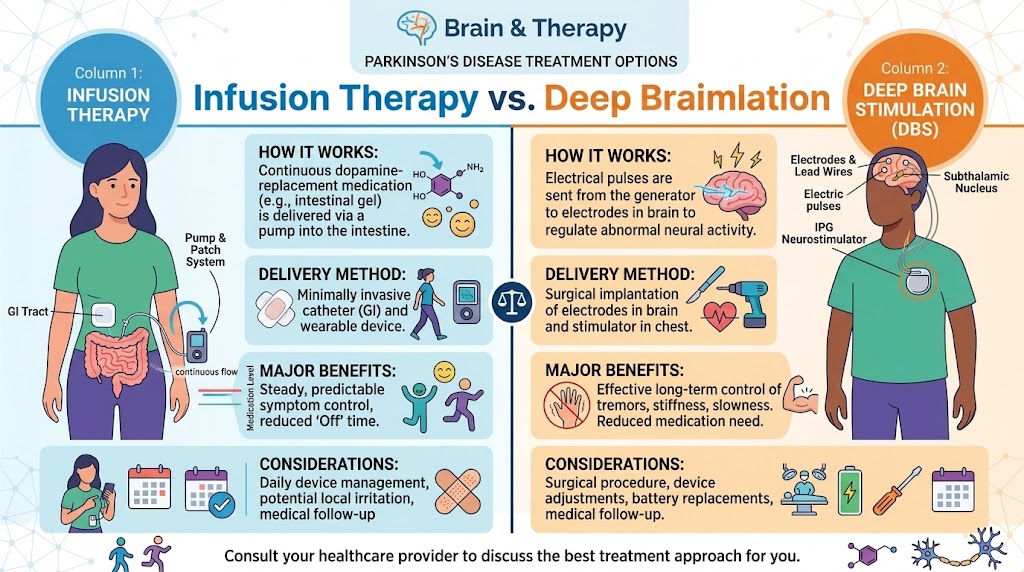
Infusion Therapy vs. Deep Brain Stimulation
Click Here To Watch Video to Treat Parkinson’s Disease Naturally!..
Infusion therapy and deep brain stimulation (DBS) are both advanced treatment options, but they work very differently.
DBS uses implanted electrodes to deliver electrical stimulation to specific brain regions involved in movement.
Infusion therapy delivers medication continuously or at controlled rates.
DBS requires brain surgery and implanted hardware. Infusion therapy generally does not involve placing electrodes in the brain, although some infusion methods require specialized delivery tubes or infusion equipment.
The best option depends on factors such as symptoms, medication response, cognitive health, surgical suitability, lifestyle, and personal preferences.
A movement-disorders specialist can help compare the available options.
Does Infusion Therapy Cure Parkinson’s Disease?
No.
Infusion therapy does not cure Parkinson’s disease.
Parkinson’s is a progressive neurological condition, and current treatments primarily focus on managing symptoms and maintaining function.
The goal of infusion therapy is to improve medication delivery and provide more consistent control of certain motor symptoms.
Some patients may experience meaningful improvements in mobility and daily functioning, but the treatment does not stop the underlying disease process.
Can Infusion Therapy Improve Quality of Life?
For appropriately selected patients, better control of motor fluctuations may improve quality of life.
When “off” periods become less frequent or less severe, patients may be able to participate more consistently in daily activities.
Potential improvements may include:
- Greater independence
- Easier movement
- More predictable daily routines
- Increased ability to participate in activities
- Less disruption from medication wearing-off
However, quality-of-life benefits vary, and non-motor Parkinson’s symptoms may require separate treatment.
The Importance of Follow-Up Care
Starting infusion therapy is not the end of treatment.
Regular follow-up is important to ensure that medication delivery and symptom control remain appropriate.
Doctors may adjust the infusion rate, medication regimen, or other aspects of treatment based on the patient’s response.
Patients should also discuss any new side effects, changes in mobility, sleep problems, mood changes, or cognitive symptoms with their healthcare team.
Ongoing care helps ensure that treatment continues to match the patient’s changing needs.
Final Thoughts
Infusion therapy can be an important advanced treatment option for selected people with Parkinson’s disease who experience significant motor fluctuations despite optimized conventional medications.
By delivering medication continuously or in a controlled manner, infusion therapy may help reduce “off” time, smooth motor fluctuations, improve mobility, and make symptom control more predictable.
However, infusion therapy is not suitable for everyone. Different infusion treatments have different delivery methods, benefits, risks, and practical requirements.
The decision should be made together with a movement-disorders specialist after a detailed assessment of symptoms, medication response, overall health, lifestyle, and treatment goals.
If Parkinson’s symptoms are becoming difficult to control between medication doses, ask your healthcare provider whether an advanced treatment—including infusion therapy, DBS, or another option—may be appropriate for your individual situation.

